

Table of Contents
- Why Printing Method Matters for Your Deadline
- Direct-to-Garment Printing: Same-Day Custom T-Shirt Printing
- Screen Printing Turnaround Time for High-Volume Orders
- Direct-to-Film Printing Turnaround Time and Quality
- Embroidery and Heat Transfer Methods
- Fast Custom Apparel Printing: Choosing by Your Deadline
- Shipping, Proof Approval, and Delivery Guarantees
- Quality and Durability When Speed Matters
- Frequently Asked Questions
Last Updated: October 6, 2026
Why Printing Method Matters for Your Deadline
The printing method you choose determines how fast you can deliver custom apparel, and understanding custom apparel printing methods is essential for meeting your deadline.
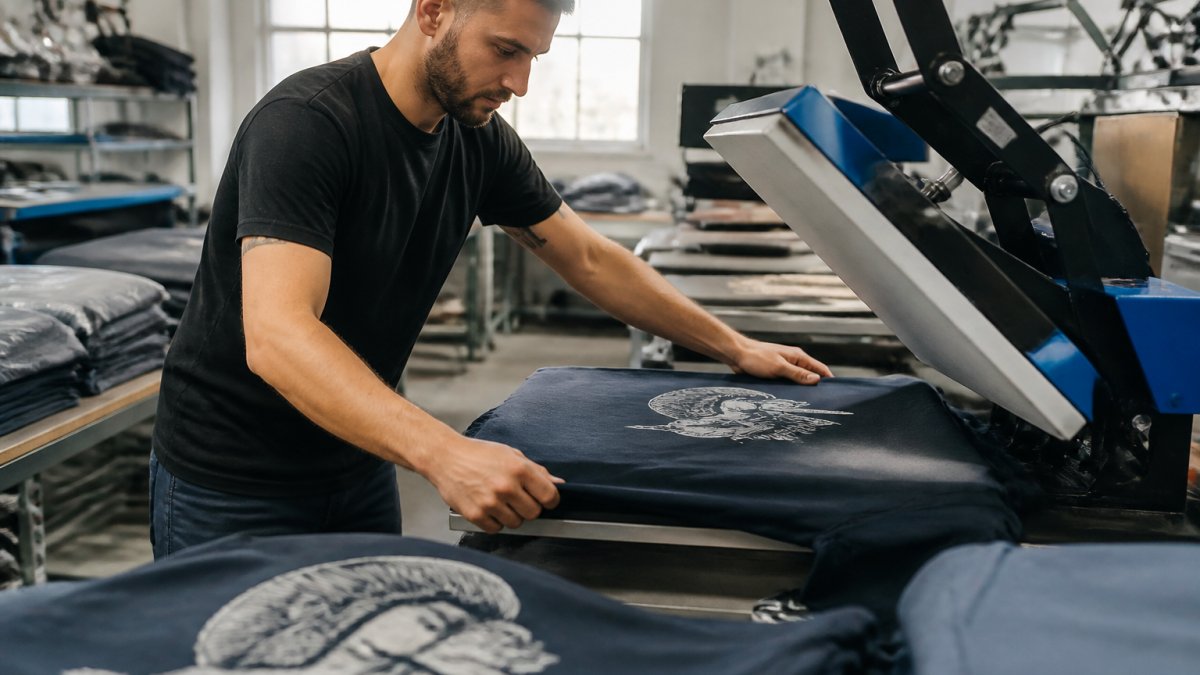
Most people assume all printing methods scale at the same speed. A technique that works for a single shirt might bottleneck at 500 units.
Here's what determines whether your custom apparel printing arrives on time.
Direct-to-Garment Printing: Same-Day Custom T-Shirt Printing
Direct-to-garment printing (DTG) is the fastest option for small orders and personalized apparel. The printer applies ink directly to the fabric using inkjet technology, with no screens, no setup delays, and no minimums.
How DTG Works
DTG printers use specialized inkjet heads that spray water-based or plastisol inks onto garment fibers. The process has three steps: pre-treatment (which opens the fibers so ink bonds), ink application, and heat curing (which sets the ink permanently).
A single shirt takes 5-10 minutes including curing, making DTG ideal for one-off orders, small batches, and rush requests. You can print multiple designs the same day without changing equipment.
Pros and Cons
What works: DTG delivers vibrant, photo-quality prints on 100% cotton. The color range is unlimited, so you can print photorealistic images, gradients, and complex artwork without ink separation. Setup is minimal, so small orders don't inflate per-unit cost, and same-day or next-day dispatch is realistic.
What doesn't: DTG struggles with dark garments unless you use a white ink base layer, which adds time and cost. Per-unit cost is higher than screen printing for large orders, and DTG requires 100% cotton or cotton-blend fabrics, since polyester and low-cotton blends don't hold ink well.
Screen Printing Turnaround Time for High-Volume Orders
The method uses a mesh screen with stenciled designs, pushing ink through the screen onto the garment below.

How Screen Printing Works
A separate screen is created for each ink color, then aligned on a multi-station press. The garment moves through stations, receiving one color at a time, then gets heat-cured.
Setup takes the longest: creating screens and aligning the press typically requires 2-4 hours for a new design. Once complete, experienced operators can print 200-400 shirts per hour, which is why screen printing excels at volume.
Speed Trade-Offs by Order Size
For orders under 50 units, screen printing is slower than DTG because setup overhead dominates. The break-even point is around 50-100 units, depending on design complexity.
For orders of 100+ units, screen printing becomes the fastest economic option.
Design simplicity accelerates screen printing: a single-color design prints faster than a five-color one because fewer screens and color stations are needed. White ink also requires longer curing than darker inks, adding 1-2 hours to a large run.
Direct-to-Film Printing Turnaround Time and Quality
Direct-to-film printing (DTF) is a newer technology gaining traction for its speed and versatility. It prints designs onto a special film, then transfers them with a heat press.
DTF Process and Timeline
DTF printers apply ink to a polyester film, cure it with heat, then apply a powder adhesive while the ink is wet. The film is pressed onto the garment with heat and pressure.
Unlike DTG, DTF works on any fabric: 100% cotton, polyester, blends, dark or light. You can print the same design across multiple garment types without adjusting settings.
Turnaround is competitive with DTG for small orders: a rush DTF order can ship within 24 hours.
When to Choose DTF
If your order includes both cotton t-shirts and polyester hoodies with the same design, DTF is your only single-method solution, screen printing needs different ink formulations, and DTG won't work on polyester. Streamlining your production process in this way remains the most efficient path toward achieving same day printing for diverse fabric blends.
Print quality is sharp and vibrant, slightly less detailed than DTG on cotton.
Cost sits between DTG and screen printing: DTF is more expensive than screen printing under 100 units, while screen printing edges ahead on price over 200 units.
Embroidery and Heat Transfer Methods
Embroidery and heat transfer are the slowest methods, but they deliver a premium aesthetic that justifies the timeline.
Embroidery Speed and Durability
Embroidery stitches thread directly into the garment. Each design requires programming the machine, which takes 1-2 hours for a complex logo. Once programmed, a single embroidered design takes 10-30 minutes depending on stitch count.
The real bottleneck is setup: a rush embroidery order typically requires 3-5 business days because the design must be digitized and the machine programmed before production.
The raised stitches convey a premium, tactile quality.
The downside: embroidery can't reproduce photorealistic designs or complex gradients. Logos work beautifully; photographs don't. Color range is limited to available threads, and intricate details get lost in the stitch pattern.
Heat Transfer and Sublimation Timelines
Heat transfer applies a pre-printed design to a garment using heat and pressure. The design is printed separately on transfer paper or film, then adhered at 2-5 minutes per garment once the transfer is ready.
The bottleneck is printing the transfers.
Sublimation is a specialized heat transfer method that works only on polyester and polyester-blend garments. The dye vaporizes under heat and bonds to the synthetic fibers, creating extremely durable, vibrant prints. Turnaround is similar: fast once printing is complete.
Fast Custom Apparel Printing: Choosing by Your Deadline
Your deadline determines which printing method works. Here's how to match your timeline to the right technique.
The Pharmaceutical Industry Does Not Create Cures, it Creates Customers T-Shirt →
Need It in 24 Hours
Same-day or next-day delivery is possible with the right conditions.
Heat transfer works if your design is already prepared. You're essentially paying for expedited printing and shipping, not production time.
Embroidery and screen printing are off the table. Setup times alone exceed 24 hours.
Vireous.Shop offers same-day or next-day dispatch for personalized items using DTG technology, making rush orders feasible without sacrificing print quality.
Need It in 3-5 Days
This timeline opens up more options. Screen printing becomes viable for orders of 50+ units, with time for design approval, screen creation, and production without rush fees. DTG remains an option for smaller orders.
DTF is also realistic: order 100-200 units and receive them within 5 business days.
Heat transfer works well here because you have time for proper transfer printing and quality checks. Embroidery is possible if your design is simple and needs minimal digitization.
Need It in 1-2 Weeks
This is the sweet spot for most methods. Screen printing is optimal for orders of 100+ units, offering the fastest per-unit cost and best quality control. Design approval, screen creation, production, and inspection all fit within 10-14 days.
Embroidery becomes practical. Complex logos can be digitized and multiple units produced without rushing the machine operator.
Sublimation on polyester is an excellent choice here, with time to print transfers, apply them carefully, and quality-check each piece.
Shipping, Proof Approval, and Delivery Guarantees
Printing speed is only half the equation. Shipping, design approval, and cutoff times determine your actual delivery date.
Design Proof and Cutoff Times
Most custom apparel shops require design approval before production, adding 1-2 days. You submit artwork, receive a proof, approve it, and then production begins.
Cutoff times matter. Many shops stop accepting new orders at a specific time each day, often 2 PM or 5 PM. Submit after the cutoff and production doesn't start until the next business day, slipping your delivery date by 24 hours.
Rush orders bypass design proof for existing designs or simple customizations. If you're reprinting an approved design, production can start immediately.
Shipping Options and Local Delivery
Standard shipping adds 3-7 business days depending on destination. Expedited shipping costs more but cuts delivery to 2-3 days. Overnight shipping is available but expensive.
Local pickup eliminates shipping delays entirely. If you're near the printing facility, you can pick up orders the same day they're completed, the fastest possible delivery method.
Some shops offer local delivery within a specific radius, faster than shipping but slower than pickup.
Quality and Durability When Speed Matters
Rushing production doesn't have to mean sacrificing quality. Different methods handle speed differently.
DTG maintains excellent quality on rush orders because there's no setup time to compromise.
Screen printing quality depends on operator experience.
Heat transfer durability depends on proper curing temperature and time.
The Method to the Madness T-Shirt uses DTG printing on heavy cotton.

| Printing Method | Ideal Order Size | Turnaround Time | Per-Unit Cost | Best For |
|---|---|---|---|---|
| Direct-to-Garment (DTG) | 1-100 units | Same-day to 2 days | Higher for small orders | Rush orders, personalized items, photo-quality designs |
| Screen Printing | 50+ units | 3-7 days | Lower for high volume | Large orders, simple designs, cost-efficiency |
| Direct-to-Film (DTF) | 10-200 units | 1-3 days | Mid-range | Mixed fabric types, dark garments, fast turnaround |
| Embroidery | 10+ units | 3-5 days | Higher | Premium logos, durability, tactile quality |
| Heat Transfer | 5+ units | 2-4 days | Mid-range | Simple designs, quick production, budget-friendly |
Choosing the right custom apparel printing method comes down to three factors: deadline, order quantity, and design complexity.
The biggest mistake is choosing a method on price alone without considering your deadline.
When you're ready to print, Vireous.Shop makes it easy to create unlimited unique designs with our AI-powered design tools. We offer same-day or next-day dispatch for personalized apparel, so your rush orders actually ship on schedule. Customize your design and see how fast we can deliver your custom apparel.

Frequently Asked Questions
What is the fastest method for custom apparel printing?
Direct-to-garment (DTG) printing is the fastest method for small orders and single pieces, with turnaround times as quick as same-day or next-day dispatch. DTG works by printing directly onto the garment using inkjet technology, eliminating setup time. For larger orders, screen printing can be faster per unit once screens are made, though initial production takes longer. Direct-to-film (DTF) printing offers a middle ground, typically ready in 2-3 days.
Can custom t-shirts be printed and shipped the same day?
Yes, same-day custom t-shirt printing is possible with direct-to-garment (DTG) technology. Vireous.Shop offers same-day or next-day dispatch for personalized items. The catch is that same-day orders require proof approval early in the business day and depend on your location for shipping speed. Weekend or holiday rush orders may not meet same-day timelines, so confirm cutoff times before placing your order.
Is direct-to-garment printing faster than screen printing?
For single items or small orders, DTG is faster because there's no screen setup required. DTG turnaround is typically 1-2 days. Screen printing requires creating screens first, which adds 1-2 days of setup time, making it slower for orders under 20 pieces. However, for bulk orders of 50+ items, screen printing becomes faster and cheaper per unit because the setup cost is spread across many garments. Choose DTG for speed on small runs; screen printing for volume.
How long does direct-to-film printing take?
Direct-to-film (DTF) printing typically takes 2-3 business days from proof approval to dispatch. The process involves printing your design onto special film, then heat-pressing it onto the garment. DTF works well for multi-color designs. It's faster than screen printing setup but slower than DTG, making it ideal when you need quality and reasonable speed for orders of 5-50 pieces.
What affects the turnaround time for custom apparel?
Several factors affect turnaround: printing method (DTG fastest, screen printing slowest upfront), order quantity (large orders may have different timelines), design complexity (more colors or details may slow production), proof approval speed (delays here push back the entire timeline), and shipping method (local pickup is faster than standard shipping). Garment availability also matters; popular sizes ship faster than specialty sizes. Always confirm cutoff times for same-day or next-day orders.