

Table of Contents
- Why Custom AI-Generated Hoodies Matter for Creators
- Best AI Hoodie Design Generators and Platforms
- How to Prompt AI for Apparel Design That Works
- Custom Hoodie Printing Quality Standards Explained
- The Step-by-Step Process to Order Your Custom Hoodie
- Copyright, Intellectual Property, and AI Art Ownership
- Sustainable and Eco-Friendly Printing Options
- Frequently Asked Questions
Why Custom AI-Generated Hoodies Matter for Creators
The ability to buy custom AI-generated hoodies online has fundamentally changed how creators build their personal brand. Instead of relying on generic merchandise or expensive traditional design processes, creators can now generate unique apparel designs in minutes using natural language prompts, then order small batches or single pieces without minimum order requirements.
For vloggers, streamers, and social media influencers, this shift matters because it removes the friction between creative vision and physical product. You no longer need to hire a designer, negotiate with manufacturers, or commit to bulk orders. A few words describing your aesthetic, your brand colors, or your audience's values can become a hoodie in your hands within days (the FTC).
The real opportunity lies in speed and personalization. Traditional apparel manufacturing demands compromise: you pick from existing designs, negotiate minimums, and wait weeks for production. AI-generated custom hoodies compress that timeline while expanding creative possibility. This is particularly valuable for creators with smaller audiences who can't justify bulk orders, yet want merchandise that feels authentic to their brand.
Best AI Hoodie Design Generators and Platforms
The market for AI-powered apparel design has matured significantly. Platforms now integrate text-to-image generation directly into the ordering workflow, meaning you can design and purchase without leaving a single interface.
Vireous.Shop stands out as a top choice for creators seeking seamless AI-to-apparel integration. The platform combines OpenAI's DALL-E 3 technology with made-to-order printing, allowing you to generate designs from natural language prompts and immediately preview them on actual garments. The interface handles the technical complexity of converting AI art into print-ready files, and same-day or next-day dispatch means your custom hoodie arrives faster than traditional manufacturing. The Money Back Guarantee removes purchase friction for first-time buyers concerned about print quality.
What distinguishes Vireous.Shop from some alternatives is the direct integration with OpenAI's API. You're generating designs with the same technology powering professional creative workflows. The platform also offers private label options, meaning creators can white-label merchandise for their audiences without Vireous.Shop branding.
Other platforms serve different needs. Some focus on bulk ordering and team collaboration, which suits established brands with larger audiences. Others prioritize template libraries over generative design, which works well if you prefer customizing existing designs over creating from scratch. The key distinction: generative platforms like Vireous.Shop give you unlimited design possibilities through prompts, while template-based platforms constrain you to predefined styles.
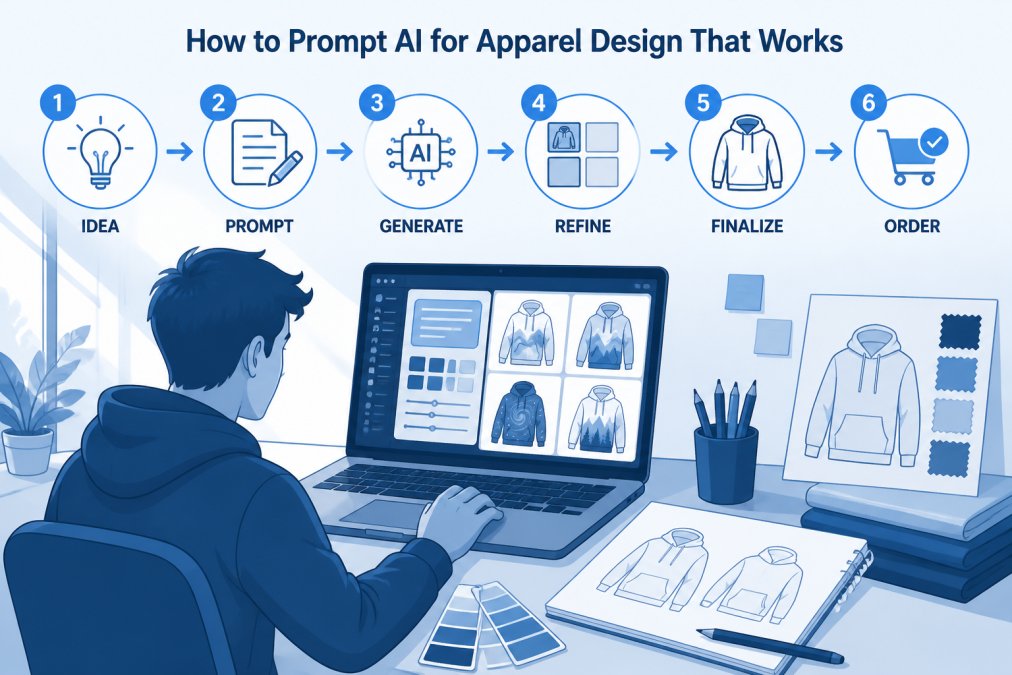
How to Prompt AI for Apparel Design That Works
Generating apparel designs with AI requires a different approach than creating fine art. Apparel has constraints: the design must work at scale on fabric, maintain legibility at small sizes, and translate well through printing processes. Your prompts need to account for these realities.
Crafting Effective Text Prompts
The most common mistake is treating apparel prompts like fine art descriptions. A prompt like "a beautiful, surreal landscape" might produce a stunning image that looks terrible printed on a hoodie at 8 inches wide. Apparel design prompts need specificity about scale, composition, and technical requirements.
Effective prompts for hoodie design include:
- Clear subject matter: "minimalist geometric logo" beats "abstract modern art"
- Intended scale: "design for front chest placement, 6 inches wide"
- Color constraints: "limited to 3 colors: navy, white, and gold"
- Style reference: "streetwear aesthetic" or "vintage band tee style"
- Technical clarity: "bold outlines" or "high contrast" (helps with print reproduction)
A weak prompt: "cool hoodie design" A strong prompt: "minimalist streetwear logo for front chest, 4 inches wide, bold sans-serif text reading 'CREATE' in white on navy background, high contrast for direct-to-garment printing"
The strong prompt constrains the AI model's output, making it more likely to produce something actually printable. You're directing creativity toward apparel-specific requirements.
Refining and Upscaling Your Design
Most AI-generated images start at modest resolution. Upscaling, mathematically enlarging the image while preserving detail, is necessary before ordering.
Vireous.Shop handles upscaling automatically, converting your AI-generated design into print-ready files. This removes a technical barrier that stops many creators from shipping custom apparel. The platform's integration with OpenAI means you're working with upscaling algorithms optimized for the same generative model you used.
After upscaling, review the design at actual print size. Most platforms, including Vireous.Shop, provide mockup generators that show your design on an actual hoodie. This preview step catches problems before you commit to ordering.
Custom Hoodie Printing Quality Standards Explained
Not all printing methods produce the same results. The choice between direct-to-garment (DTG) and screen printing affects color vibrancy, durability, and design compatibility.
Direct-to-Garment vs. Screen Printing
Direct-to-garment printing applies ink directly to fabric using inkjet technology (peer-reviewed research). The advantage: unlimited colors, photorealistic detail, and no setup costs for small runs. The disadvantage: ink sits on top of fabric rather than bonding into it, which can fade with washing over time.
Screen printing pushes ink through a mesh screen onto fabric (peer-reviewed research). Each color requires a separate screen, making it expensive for multi-color designs but ideal for simple, bold graphics. Screen-printed designs bond into fabric and last longer through repeated washing. The tradeoff: you're limited to fewer colors, and fine details can blur.
For AI-generated designs, direct-to-garment is usually the better choice. AI art often includes color gradients, complex details, and photorealistic elements that screen printing struggles to reproduce. DTG preserves these details.
Vireous.Shop uses direct-to-garment printing, which aligns well with AI-generated designs that typically include gradients and color complexity.
What to Expect in Print Quality
High-quality DTG printing produces vibrant colors with sharp detail. You should expect color accuracy within a reasonable range of your screen preview, sharp text and edges, smooth color transitions, and no visible ink bleeding.
When evaluating a custom hoodie, check the mockup preview carefully. Vireous.Shop's preview system shows your design on actual garment photos, giving you a realistic sense of how colors will appear. If the preview looks crisp and vibrant, the final product typically matches.
One factor to note: fabric weight and texture affect how prints appear. A heavyweight hoodie (14+ ounces) shows prints differently than a lightweight option. Heavier fabric can make prints appear slightly duller because the weave absorbs light differently. This is normal and not a quality issue.
The Step-by-Step Process to Order Your Custom Hoodie
Ordering a custom AI-generated hoodie involves three core steps: generating or uploading your design, customizing your preview, and placing your order. The entire process typically takes 10-20 minutes.
Generate or Upload Your Design
Start by creating your design. You have two paths: generate it using AI, or upload an existing image.
For AI generation, you'll enter a text prompt describing your vision. Vireous.Shop's interface guides you through prompt construction with examples and suggestions. If you're new to prompting, start specific: describe the subject, style, colors, and intended placement.
If you already have artwork, a sketch, photograph, or design file, you can upload it directly. The platform converts it into a print-ready format, handling color separation and resolution automatically.
Customize Your Mockup and Preview
Once you have your design, you'll customize how it appears on the hoodie. This step is critical because it's your last chance to catch issues before ordering.
You'll select:
- Hoodie color and style
- Design placement (front chest, full back, sleeve)
- Design size and position
- Any text additions or modifications
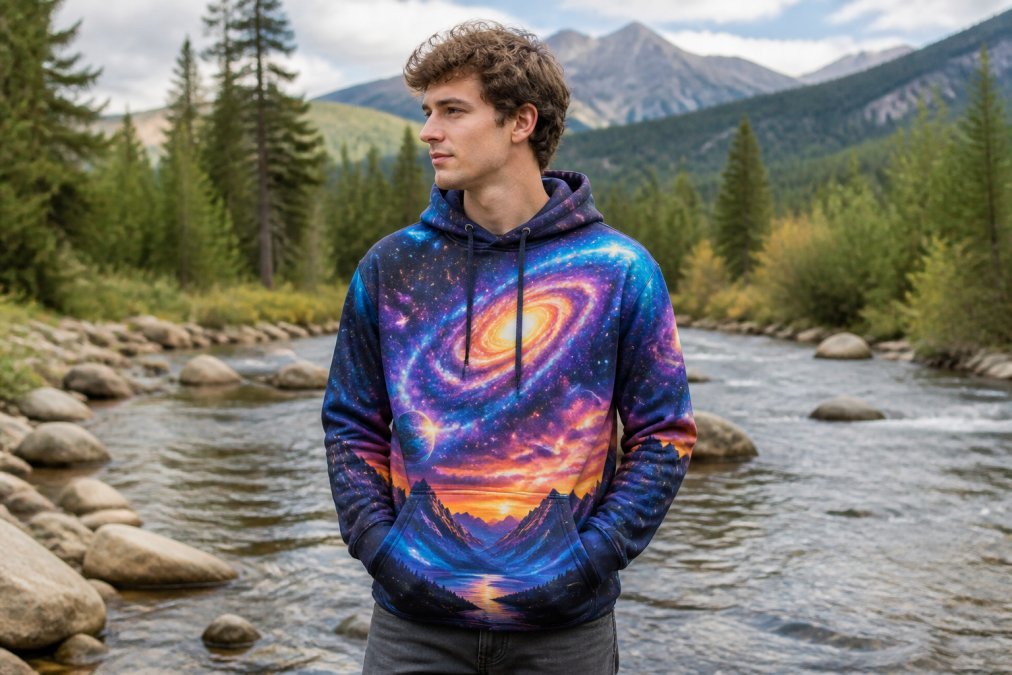
The mockup generator shows your design on a realistic hoodie photo. If the preview shows your design at the correct size and position with accurate colors, that's what will arrive.
Place Your Order
Review your mockup one final time, then proceed to checkout. You'll select quantity (most platforms have no minimum order requirements), shipping address and speed, and any add-ons.
Vireous.Shop offers same-day or next-day dispatch, significantly faster than traditional apparel manufacturing. This speed comes from their on-demand printing workflow: they don't batch orders or maintain inventory. Your hoodie prints and ships immediately after you order.
The Money Back Guarantee means you can order with confidence. If the hoodie doesn't match the preview or falls short of quality standards, you get your money back.
Copyright, Intellectual Property, and AI Art Ownership
If you generate a design using AI, who owns it? Can you legally print it on merchandise and sell it? What if your prompt was inspired by existing artwork?
AI-generated images occupy legal gray area that's still being defined. When you use Vireous.Shop's DALL-E 3 integration, you're generating images through OpenAI's API. OpenAI's terms grant you rights to use the generated images for most purposes, including commercial use on merchandise.
The risk emerges if your prompt describes existing copyrighted work. If you prompt for "design in the style of [famous artist]" or "logo similar to [brand]," you've instructed the AI to approximate protected work. The resulting image may infringe even though you didn't create it directly.
Best practice: generate designs that don't reference specific copyrighted works. Describe styles and aesthetics instead: "minimalist tech brand aesthetic" works; "design like Apple's logo" doesn't.
If you're selling merchandise with AI-generated designs to your audience, be transparent about it. Many creators include "AI-generated design" in product descriptions. This builds trust and aligns with emerging norms around AI disclosure.
Sustainable and Eco-Friendly Printing Options
The environmental impact of custom apparel printing matters increasingly to creators and their audiences. Direct-to-garment printing is more sustainable than traditional screen printing in some ways, less so in others.
DTG uses water-based inks that are safer for workers and produce less chemical waste than solvent-based screen printing inks. The on-demand model also means less waste from unsold inventory; you print only what's ordered. This is a meaningful advantage over traditional manufacturing.
The tradeoff: DTG uses more water during the printing process and requires more frequent equipment maintenance. Screen printing uses less water but generates more waste through screen disposal and excess ink.
What matters most is the garment itself. A high-quality hoodie worn for years has lower environmental impact than a lower-quality one worn once. Investing in durable custom apparel is the most sustainable choice.
Vireous.Shop's made-to-order model aligns with sustainability principles by eliminating inventory waste. You order what you need; they produce exactly that. This reduces the environmental footprint compared to traditional manufacturing where excess stock ends up discarded.
Ordering custom AI-generated hoodies online transforms how creators build their brand presence. The combination of unlimited design possibility through AI, fast production timelines, and no minimum order requirements removes barriers that previously existed.
Vireous.Shop addresses these challenges directly. The platform's integration with OpenAI's DALL-E 3 gives you powerful generative design tools, while their direct-to-garment printing and same-day dispatch ensure your vision arrives as intended. Start with a clear prompt describing your design, preview it carefully on their mockup generator, and order with confidence knowing the Money Back Guarantee protects you. Your custom hoodie is ready to ship faster than you'd expect.
Frequently Asked Questions
Q: How do I turn an AI image into a custom hoodie?
A: Start by generating or uploading your AI artwork using DALL-E 3 or similar tools. Then use a print-on-demand platform that accepts custom uploads. You'll customize your hoodie by selecting size, color, and placement of the design. Most platforms provide a mockup generator so you can preview exactly how your design looks on the garment before ordering.
Q: What should I look for when buying custom apparel online?
A: Check print quality standards, fabric composition, and turnaround time. Look for platforms offering direct-to-garment or high-quality screen printing. Verify mockup accuracy by comparing the preview to customer reviews. Confirm the company offers a quality guarantee or replacement policy. For creators, prioritize platforms with no minimum order requirements and fast shipping options.
Q: Can I use AI-generated designs for commercial merchandise?
A: Yes, but verify the terms. Most AI tools like DALL-E 3 grant commercial rights to generated images when you use their official API or licensed platform. However, some free AI tools restrict commercial use. Always check the terms of service for both the AI tool and the print platform. If you're selling merchandise to followers, ensure your design tool's license permits commercial apparel production. Some platforms like Vireous.Shop explicitly support commercial use through OpenAI integration.
Q: How long does it take to receive a custom AI-generated hoodie?
A: Most print-on-demand platforms offer 2-7 business day turnaround from order placement. Some services like Vireous.Shop provide same-day or next-day dispatch for personalized items. Shipping time varies by location but typically adds 3-5 business days domestically. Rush options are available if you need faster delivery. Always check the specific platform's dispatch schedule before ordering, especially if you're creating merchandise for an event or campaign with a deadline.
This article was written using GrandRanker