

Table of Contents
- Why Personalized Apparel Matters for Your Creator Brand
- Print on Demand for Influencers: Building Merch Without Inventory Risk
- Custom Apparel Design Tips That Convert Followers Into Buyers
- Retail Quality Merch vs. Print-on-Demand: What Your Audience Actually Notices
- Profit Margin Analysis: What You Actually Keep as a Creator
- Production Methods: Screen Printing, Direct-to-Garment, and Embroidery Explained
- Scaling Your Creator Merch Without Managing Inventory
- Conclusion
Last Updated: August 5, 2026
Why Personalized Apparel Matters for Your Creator Brand
Building a creator brand means giving your audience a way to wear your identity. Personalized apparel transforms passive followers into active brand ambassadors who literally advertise for you. Unlike generic merchandise, your designs reflect your actual aesthetic and creative vision, not something mass-produced that could belong to anyone.
Modern personalized apparel solutions let you sell one piece at a time without managing inventory.
Print on Demand for Influencers: Building Merch Without Inventory Risk
Print on demand solves the biggest barrier to entry: you don't need to bet thousands of dollars on inventory you might not sell. Each item is created only when someone orders it, eliminating unsold stock.
This model lets you iterate based on what actually sells. If your audience loves black hoodies but ignores white ones, you'll know within days and can adjust accordingly. For influencers managing multiple revenue streams, the operational simplicity is enormous, production and fulfillment happen automatically once someone places an order.
Same-day or next-day dispatch builds trust and encourages repeat purchases. A creator with 5,000 followers can launch a merch drop on Monday and have items shipping by Wednesday.
The trade-off is per-unit cost. Print on demand pricing is higher than bulk manufacturing, so your profit margin per item is smaller. If you're selling a t-shirt for $25, your take-home might be $8-12 depending on the production method and platform.

Platforms like Vireous.Shop handle the entire fulfillment chain. You upload your design, set your price, and the platform manages production, quality control, and shipping. Integration with AI design tools means you can generate unique designs from text prompts, dramatically speeding up your creative process.
Custom Apparel Design Tips That Convert Followers Into Buyers
The difference between a design that sells and one that sits is specificity. Your design needs to feel like it belongs to your audience and reflects your unique brand identity.
Start with your brand's visual language. What colors dominate your content? What style resonates with your followers, minimalist, bold, retro, avant-garde? Your apparel design should feel like a natural extension of what people already know and love about you.
Logo placement matters more than most creators realize. A small, centered chest logo works for broad appeal. A large back print creates a statement piece. Sleeve logos feel premium and designer-like. Understand where your logo will actually appear on the garment.
Color matching is where many designs fail. What looks perfect on your screen might print differently depending on the fabric and production method. Request samples before launching a full production run.
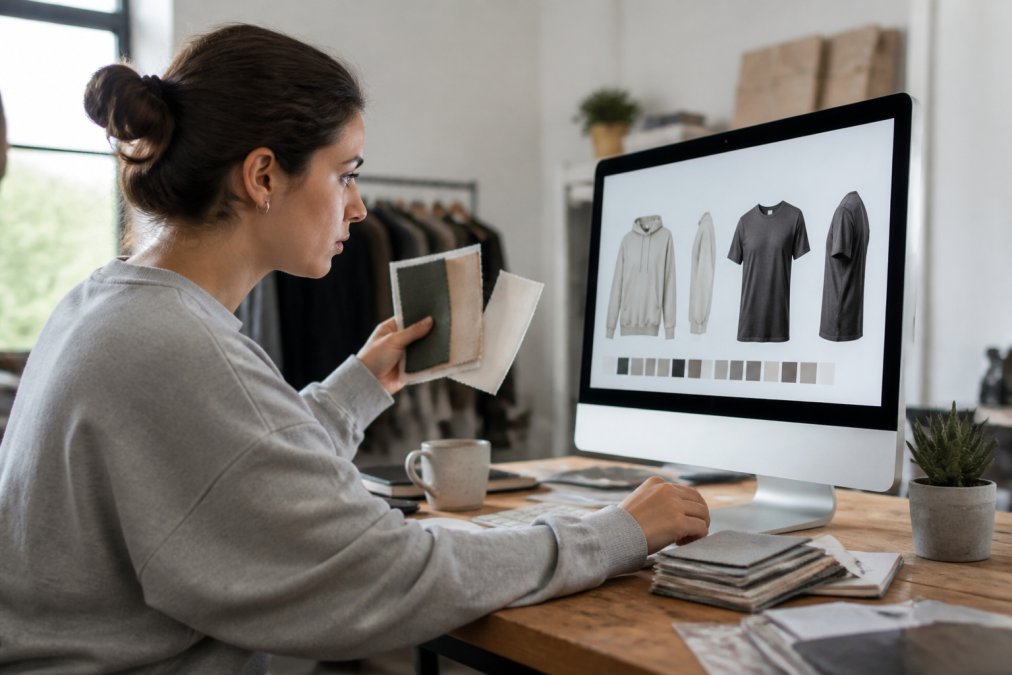
Typography deserves serious attention. Thin, delicate fonts often fail in print, especially at smaller sizes. Bold, legible fonts that reflect your brand voice are safer bets.
Using AI Design Tools to Speed Up Your Workflow
AI design generation has fundamentally changed how creators approach custom apparel design. Rather than spending weeks sketching or paying a designer thousands of dollars, you can generate dozens of design variations in hours using natural language prompts.
The workflow is straightforward: describe what you want in plain English, the AI generates visual options, and you refine from there. The quality of AI-generated designs depends heavily on how specific your prompt is. Detailed prompts that reference your brand aesthetic, specific design elements, and color preferences produce designs that actually feel like yours.
Vireous.Shop's integration with DALL-E 3 means you're working with one of the most capable image generation models available. Better tools produce designs with cleaner lines, more accurate color representation, and fewer visual artifacts.
Logo Placement and Color Matching for Brand Consistency
Your logo is your brand's signature. Where it appears on your apparel determines how recognizable the product is and how wearable it feels. Standard placements work because they're proven: chest placement for classic appeal, back placement for statement pieces, sleeve placement for premium feel.
Color matching requires understanding the technical difference between screen colors and print colors. Your monitor displays colors using RGB light, while printed apparel uses CMYK pigments. A vibrant blue on screen might print as a muted teal on fabric. Professional print-on-demand services provide color swatches so you can see exactly what you're getting.
Retail Quality Merch vs. Print-on-Demand: What Your Audience Actually Notices
Retail-quality merchandise is manufactured in bulk with premium fabrics and reinforced construction. Print-on-demand quality has improved dramatically. Modern direct-to-garment printing creates vibrant, durable designs, and fabric quality is solid enough that your followers won't feel like they bought something cheap.
What actually matters to your audience: does the product match the preview they saw? Does the design look like what you showed them? Does it feel like quality for the price? Print-on-demand excels at the first two.
If you're selling a print-on-demand t-shirt for $18, your followers expect decent quality at that price point. If you're selling it for $35, they expect retail-quality construction and premium fabric. Price honestly, a print-on-demand t-shirt is worth $20-28, while a premium embroidered piece is worth $35-50.
Profit Margin Analysis: What You Actually Keep as a Creator
Understanding your actual profit margin determines whether merch is worth your time. Say you're selling a personalized apparel item for $25. Production cost through print-on-demand is typically $8-12. Platform fees are $1-2, and payment processing takes another $0.75-1.50.
Your take-home is roughly $11-15 per item sold, a 44-60% margin. This matters when you factor in your time and marketing effort.
For most creators, print-on-demand margins make sense when you're selling 50+ items per month. Below that volume, you're spending more time managing the program than the profit justifies. Above that volume, consider whether bulk manufacturing makes financial sense.
The real profit opportunity isn't in t-shirts. It's in higher-margin items like hoodies, limited editions, and exclusive designs. A $45 hoodie with $18 production cost gives you $27 per sale, making merch meaningful revenue.
Production Methods: Screen Printing, Direct-to-Garment, and Embroidery Explained
Screen printing pushes ink through a mesh screen onto fabric. It's ideal for bold, simple designs with limited colors. The print is durable and vibrant, but setup costs make it uneconomical for single items. Screen printing excels for designs produced hundreds of times.
Direct-to-garment printing uses inkjet technology to print designs directly onto fabric. It handles complex, multi-color designs beautifully with no setup cost, making it perfect for one-off or small-batch orders. The print feels slightly stiffer than screen printing, and durability depends on ink quality.
Embroidery creates designs by stitching thread into fabric, producing a premium, tactile result. It works best for simple designs and logos. Complex designs with fine details don't translate well. The cost is significantly higher, limiting it to premium items.
Most print-on-demand platforms use direct-to-garment because it's flexible and cost-effective. Vireous.Shop uses this method, allowing you to create complex designs with unlimited colors without production constraints.
Scaling Your Creator Merch Without Managing Inventory
Start by testing what actually sells. Launch 3-5 designs and track which ones convert. After two weeks, you'll know which designs are winners and which are duds.
Once you've identified winners, expand the product line for those designs. If your t-shirt design converts well, offer it on hoodies, long sleeves, and hats. Each new product format expands revenue without creating inventory risk.
Build a sustainable launch cadence. Monthly design drops create anticipation and give followers a reason to check back. Monthly hits the sweet spot for most creators.
The operational simplicity of print-on-demand is the real advantage at scale. The platform handles everything. Your job is creating designs people want and driving traffic to them.
Integration with your audience is critical. Announce new designs to your email list and social followers before launch. Create unboxing content showing actual product quality. Ask followers what designs they want to see next. This turns merch from a side project into a community experience.
Pricing strategy matters more as you scale. If you're selling 500 items per month at $25, your total revenue is $12,500 gross. After production costs, you're keeping roughly $6,000. That's meaningful income, but it required consistent traffic and a product your audience actually wants.
The creators who scale merch successfully treat it like a product business. They test, measure, iterate, and optimize based on data. They invest in product photography and descriptions. They respond to customer feedback.
Building personalized apparel for your creator brand deepens your relationship with your audience. They're not just consuming your content, they're wearing your identity and becoming ambassadors for what you've created.
Vireous.Shop removes the technical barriers to entry. With AI-powered design generation, same-day dispatch, and a money-back guarantee, you can launch a merch program without risking capital on inventory. The platform handles production and fulfillment, so you focus on what you do best: creating content your audience loves and designs they actually want to wear.
Start small, test what works, and scale the winners.
Frequently Asked Questions
What's the best way to choose between screen printing and embroidery for my creator merch?
Screen printing works best for bold designs with solid colors and reaches larger audience budgets, it's cost-effective at scale. Embroidery creates a premium feel and works well for logos or smaller designs, appealing to fans willing to pay more. Direct-to-garment printing bridges both, handling complex artwork and photographs without setup costs. Consider your brand identity: embroidery signals premium quality, while screen printing suggests bold, statement-focused designs. Test small batches with each method to see what resonates with your audience before committing to bulk orders.
How do I ensure the personalized apparel preview matches what actually arrives?
Request physical samples before placing full orders, most print-on-demand services offer this at cost. Review the design file in high resolution, checking color accuracy, logo placement, and text clarity. Ask your provider about their quality assurance process and whether they use color-matching standards. With platforms offering same-day or next-day dispatch, you can test small quantities quickly and refine designs based on real feedback. Always check customer reviews mentioning print quality, and confirm that your preview tool accurately represents final output by comparing past orders to their mockups.
Can I actually use print-on-demand services to build merch at scale as a micro-creator?
Yes, print-on-demand is specifically designed for creators without inventory capital. You only pay for items sold, eliminating risk. Start with 5-10 SKUs (t-shirts, hoodies, hats) and test which designs resonate. Most platforms handle fulfillment automatically, so you focus on marketing. As you grow, you'll identify bestsellers; that's when you might shift some items to bulk orders for better margins. Many successful creators with 5K-50K followers use print-on-demand exclusively because it lets them test merchandise ideas without financial risk, then scale winners later.
What should I look for in a print-on-demand partner to ensure retail-quality results?
Check fabric weight (heavier fabrics feel premium, look for 6 oz minimum for t-shirts), shrinkage rates, and color durability through wash cycles. Read customer reviews specifically mentioning print longevity and fit consistency. Verify they use high-quality blanks from established suppliers, not cheap alternatives. Ask about their quality assurance process, turnaround times, and replacement policy for defects. Platforms offering same-day or next-day dispatch often maintain stricter quality standards because slow fulfillment would expose flaws. Request samples across different products and colors before launching to your audience.
This article was written using GrandRanker