

Table of Contents
- Define Your Target Audience and Brand Identity
- Design Principles for Professional Vlogger Merch
- Merch Design Ideas for Vloggers That Drive Engagement
- Selecting the Best Print-on-Demand Services for Creators
- Copyright Laws for Creator Merchandise and Brand Protection
- How to Market Merch to Your Audience and Build Loyalty
- Setting Up Your E-Commerce Storefront and Managing Inventory
- Quality Assurance and Launch Strategy
Last Updated: August 16, 2026
Define Your Target Audience and Brand Identity
Before you touch design software, you need clarity on who's actually buying your merch. Most vloggers skip this step entirely, they design something they like and hope their audience agrees. That's backward.
Start by segmenting your audience. Are they tech enthusiasts? Gamers? Philosophy students? Your merch should speak directly to the specific subgroup most likely to convert. A vlogger with 50K followers interested in quantum physics will have completely different merch needs than a lifestyle creator with 50K followers.

Your brand identity shapes everything downstream. The color palette, typography, messaging, and product selection all flow from who you are and what your audience expects from you. This isn't about being generic, it's about being deliberate. If your brand is edgy and irreverent, your merch should feel that way. If you're known for thoughtful, educational content, your merch should reflect that tone.
Document three things: your core audience persona (age, interests, values), your brand's visual identity (what colors and styles feel authentically you), and your merch's purpose (is this fan appreciation, revenue generation, or community building?). This foundation prevents costly design mistakes later.
Adobe's guide to brand identity strategy emphasizes that consistent visual identity increases brand recognition by making your products instantly recognizable. When someone sees your merch in a crowded room, they should know it's yours.
Design Principles for Professional Vlogger Merch
Good merch design isn't about being fancy, it's about being intentional. Professional vlogger merch follows three core principles: clarity, scalability, and authenticity.
Clarity means your design works at any size. A logo that looks great at 12 inches might become an unreadable blur on a small shirt pocket. Test your designs at multiple scales before finalizing them. What reads clearly on a 1920x1080 monitor might become muddy on a 2x2 inch patch.
Scalability refers to how your design adapts across different products. A design that works perfectly on a t-shirt might look awkward on a hoodie or canvas print. Professional merch designers think about how their work translates across formats, apparel, accessories, wall art, bags. Your core design elements should feel cohesive whether they're printed on cotton, canvas, or polyester.
Authenticity is what separates memorable merch from forgettable swag. Your design should reflect your actual brand voice and values. Forced, generic designs feel cheap. Designs that capture something true about your content, a catchphrase, an inside joke, a visual motif from your videos, create genuine connection with your audience.
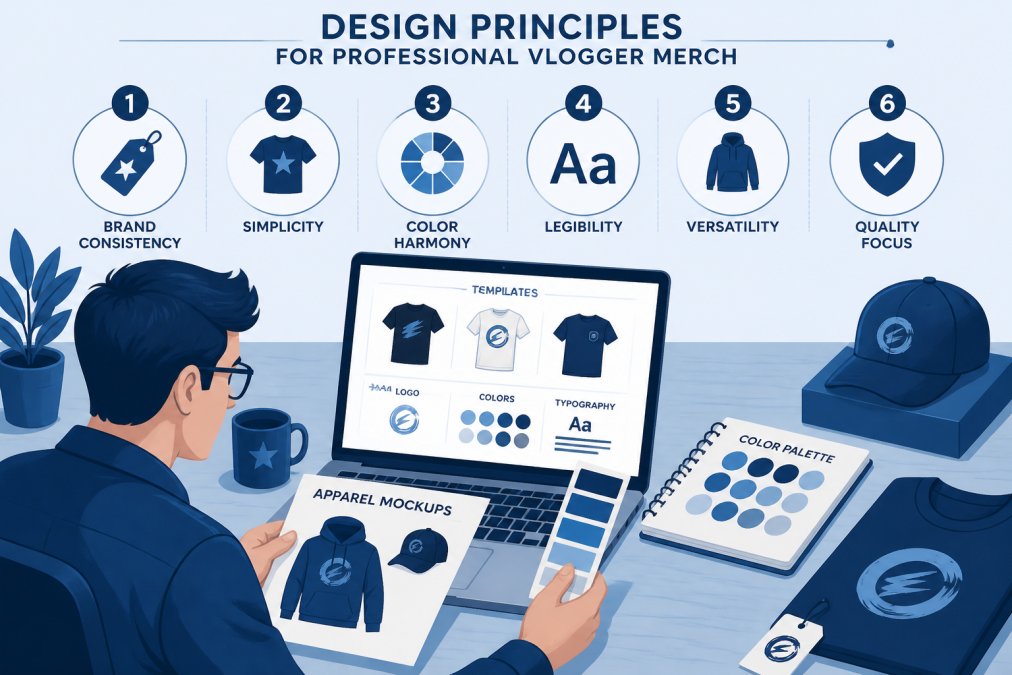
Color Palette and Typography Fundamentals
Your color palette is the fastest way your audience recognizes your merch. Limit yourself to 2-4 primary colors maximum. More than that and the design becomes chaotic.
Choose colors that align with your brand. If your video thumbnails consistently use bold orange and deep blue, your merch should echo those colors. Consistency builds recognition. A viewer scrolling through social media should instantly identify your merch by color alone.
Typography matters equally. Pick one primary typeface and stick with it across all your merch. Mixing fonts is tempting but usually creates visual chaos. Your font should match your brand personality, bold and modern, or clean and minimal, or playful and rounded. Whatever it is, commit to it.
Consider how colors and text work together on different backgrounds. Black text on a dark shirt is invisible. White text on light apparel disappears. Test your color combinations against both light and dark garments. Professional merch accounts for these realities.
File Resolution and Format Requirements
This is where most vloggers fail. They design at 72 DPI (screen resolution) and then wonder why their print looks pixelated.
For professional printing, you need minimum 300 DPI at the final print size. If your design is 12x12 inches, that's 3600x3600 pixels at 300 DPI. Screen resolution (72 DPI) looks fine on monitors but produces blurry, jagged prints.
Use vector graphics when possible. Vector files (Adobe Illustrator .AI.EPS, or .SVG) scale infinitely without quality loss. Raster files (JPG, PNG) have a fixed pixel count. If you're not comfortable with vector software, use high-resolution raster files at minimum 300 DPI.
Most print-on-demand services accept PNG, JPG, PDF, and AI files. Check your provider's specifications. Some have strict file format requirements. Submitting the wrong format means delays or rejected orders.
Merch Design Ideas for Vloggers That Drive Engagement
The best merch ideas come from your actual content. Mine your most popular videos, running jokes, and audience feedback for design inspiration.
Catchphrase merch works exceptionally well. If you have a signature phrase your audience says back to you, that's gold. Turn it into a simple, bold design. The audience wearing it becomes a walking advertisement for your channel.
Inside-joke designs create community. Long-time viewers recognize the reference immediately. New viewers ask about it, creating conversation. This drives both merch sales and channel engagement.
Minimalist logo designs age better than trendy graphics. A simple, clean logo on a quality shirt stays relevant for years. Trendy designs feel dated within months.
Collaborative designs with other creators expand your reach. If you collaborate with another vlogger, co-branded merch appeals to both audiences. Each creator promotes it to their followers.
Consider what your audience actually wants to wear. A design that looks cool on your screen might feel awkward to wear in public. Test this by showing mockups to your audience before committing to production.
Selecting the Best Print-on-Demand Services for Creators
Print-on-demand eliminates inventory risk. You don't manufacture anything until someone orders it. This is essential for creators testing merch viability.
Evaluate providers on four criteria: print quality, turnaround time, customization options, and integration with your storefront.
Print quality varies dramatically. Some services use outdated DTG (direct-to-garment) technology that fades after a few washes. Others use newer techniques that last longer. Request samples before committing. Order a test shirt and wash it multiple times. Does the print hold up?
Turnaround time matters for customer satisfaction. Standard production takes 3-7 business days. Some services offer rush options. Federal Trade Commission guidelines on fulfillment require that you ship orders within the timeframe you advertise, so be realistic about what you promise.
Customization options determine how flexible your merch can be. Can customers choose shirt colors? Can they request different sizes? Can they add personalization? More flexibility increases appeal but also increases complexity.
Integration with your storefront is crucial. Ideally, your merch platform connects directly to your website or social channels. Vireous.Shop offers this integration with OpenAI's design technology, allowing you to generate custom designs through natural language prompts or select from an AI-inspired library. This means you can create unlimited unique designs without hiring a graphic designer, customers can even request custom artwork that gets printed on apparel and wall art.
Copyright Laws for Creator Merchandise and Brand Protection
This section matters more than most creators realize. Selling merch with protected intellectual property can result in takedowns, legal action, and account suspension.
Understand what you can legally use. Your own original content, catchphrases you created, and logos you designed are yours to use. Copyrighted material you didn't create, movie quotes, character likenesses, song lyrics, requires licensing or explicit permission.
Fair use is narrower than most people think. Referencing something isn't the same as using it on merchandise for sale. A parody or commentary on copyrighted material might qualify for fair use in some contexts, but commercial merchandise is riskier. When in doubt, consult a lawyer familiar with intellectual property.
Trademark your brand name and logo if you're serious about merch. Trademarks protect your brand identity and prevent others from selling merch using your name. The U.S. Patent and Trademark Office handles trademark registration. This costs money and takes time, but protects your investment long-term.
Document your design process. Keep original files, sketches, and creation dates. If someone claims you infringed their copyright, you need proof that you created the work independently.
How to Market Merch to Your Audience and Build Loyalty
Merch is a loyalty tool first, a revenue stream second. Position it as a way for fans to support you, not as a cash grab.
Start with your most engaged audience. Your super-fans are your first customers. They've already demonstrated commitment to your content. Offer them early access to new merch designs. Give them exclusive options they can't get anywhere else.
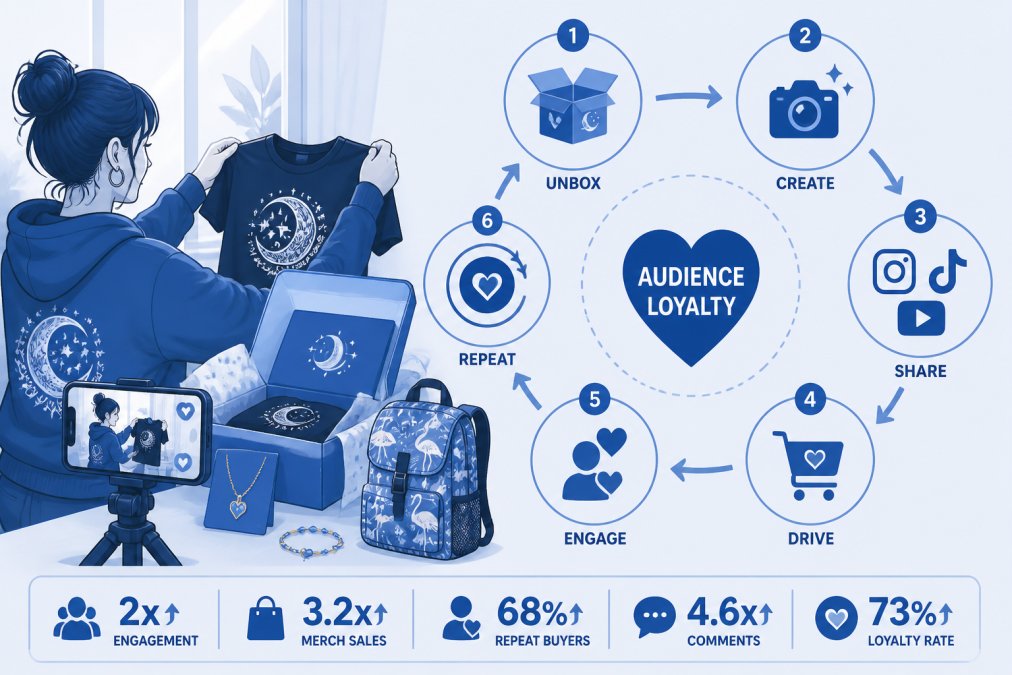
Create unboxing and styling content. Show yourself wearing the merch. Show your community wearing it. User-generated content is the most powerful marketing tool you have. When your audience sees other viewers wearing your merch, they want it too.
Be transparent about the merch production process. Explain why it costs what it costs. Show the quality of materials and printing. This builds trust and justifies pricing.
Tie merch drops to content milestones or seasonal moments. Launch new designs when you hit subscriber goals. Create limited-edition designs for holidays or special events. Scarcity drives urgency.
Engage with customers who buy. Thank them publicly. Share photos of them wearing your merch. This creates social proof and encourages others to buy.
Setting Up Your E-Commerce Storefront and Managing Inventory
With print-on-demand, inventory management is simple, you don't hold stock. But your storefront organization matters tremendously.
Structure your store logically. Group products by type: apparel, accessories, wall art. Within each category, organize by design or collection. Make it easy for customers to find what they want.
Write clear product descriptions. Include sizing information, material composition, care instructions, and shipping timeframes. Unclear descriptions lead to returns and negative reviews.
Set realistic pricing. Calculate your costs (product cost + platform fees + payment processing) and add your margin. Vireous.Shop's products range from approximately $14 to $43, giving you flexibility in how you position your merch. Premium designs justify higher prices. Basic designs work at lower price points.
Offer multiple product options. Different customers want different things. Some want a simple t-shirt. Others want hoodies, hats, or canvas prints. The more options you offer, the more revenue you generate from the same audience.
Use high-quality product photography. Show mockups on actual people wearing the items. Show different color options. Show the design from multiple angles. Professional mockups increase conversion rates.
Test your checkout process. Make sure customers can actually complete purchases. Remove unnecessary steps. Simplify the payment process. Every additional click increases cart abandonment.
Quality Assurance and Launch Strategy
Before launching merch publicly, order samples of everything. This isn't optional.
Order at least one of each product in each color option. Inspect the samples carefully. Check print quality, color accuracy, sizing, and durability. Wash samples multiple times. Does the print fade? Does the garment shrink?
If quality issues exist, address them with your provider before launch. A bad product launch damages your reputation far more than a delayed launch.
Document your findings. Take photos of the samples. Note any issues. This gives you use if you need to request reprints or refunds.
Plan your launch timing strategically. Don't launch merch when you're about to take a break from content. Launch when you're actively creating and engaging with your audience. Momentum matters.
Create a launch sequence. Start with an announcement video. Follow with posts on social channels. Reach out to your email list if you have one. Make it an event, not a casual mention.
Set realistic expectations for sales. Your first merch drop won't sell thousands of units. Most creators see 100-500 sales from their first launch. That's healthy. Build from there.
Track what sells and what doesn't. Which designs perform best? Which products do customers prefer? Use this data to inform future designs and product selections.
Launching professional vlogger merch requires thoughtful design, strategic platform selection, and authentic marketing. The most successful creators treat merch as an extension of their brand, not a side hustle. With Vireous.Shop's AI-powered design tools and fast fulfillment capabilities, you can create unlimited custom designs, from apparel to wall art, without hiring designers or managing inventory. Start with your most engaged audience, validate your designs with samples, and scale from there.
Frequently Asked Questions
How do YouTubers and vloggers design their own merch without professional software?
Most creators use AI-powered design tools and templates that don't require design experience. Platforms with DALL-E 3 integration let you generate custom designs from text descriptions. You can also customize pre-made design templates, adjust colors and typography, and use mockup generators to preview how your design looks on apparel before ordering. This approach eliminates the need for expensive design software or hiring a designer.
What are the best design tips for creator merchandise that actually sells?
Focus on simplicity: bold typography, limited color palettes (2-3 colors), and designs that reflect your brand identity. Your design should be recognizable at small sizes and work across different apparel types. Include your catchphrase, logo, or signature visual element that fans associate with you. Test designs with your audience first through polls or previews. Avoid overcrowding, white space makes professional merch stand out. Ensure file resolution meets print-on-demand requirements (300 DPI minimum) for crisp, quality results.
How do I know the design preview I see online will match the final product I receive?
Order a sample first before launching to your audience. This lets you verify color accuracy, print quality, and how the design looks on actual fabric or material. Check that the design placement aligns with your expectations and that details are sharp. Many print-on-demand providers offer sample options at reduced cost. Review the mockup tool carefully, ensure it's showing accurate color representation and placement. Document any discrepancies and contact the provider before doing a full production run.
What's the difference between print-on-demand and traditional merch manufacturing for creators?
Print-on-demand produces items only when ordered, so you don't carry inventory or pay upfront for bulk stock. This works well for smaller audiences and testing designs. Traditional manufacturing requires large minimum orders but offers lower per-unit costs at scale. For vloggers starting out, print-on-demand eliminates risk and lets you launch quickly. As your audience grows and you identify bestselling designs, you can transition to bulk orders for better margins. Print-on-demand is ideal for testing what resonates with your community.
How do I ensure my merch designs comply with copyright laws?
Only use designs, images, and text that you own or have explicit permission to use. If using AI-generated designs, verify the platform's terms, some tools grant you commercial rights automatically. Avoid copying competitor designs or trademarked logos. If your merch features fan art or references to other creators' work, get written permission first. Register your own brand logo and unique designs to protect them. When sourcing images or fonts, use licensed or royalty-free options. Consult the platform's intellectual property guidelines before launching to avoid legal issues.
What's a realistic profit margin for vlogger merch?
Print-on-demand pricing typically allows 40-60% profit margins after production costs and platform fees. For example, a t-shirt that costs $8-12 to produce can be sold for $20-25. Hoodie and premium items offer similar margins. Your actual profit depends on your retail price, production costs, shipping, and platform fees. Starting with higher margins (50%+) gives you room to run promotions and build customer loyalty. As volume increases, you can negotiate better production rates with print-on-demand providers, improving margins further.
Can I use print-on-demand for bulk merch drops, or is it only for small orders?
Print-on-demand works for any order size, but bulk drops benefit from faster turnaround and no inventory risk. If you're planning a major merch drop tied to a video launch or event, print-on-demand providers can handle large volumes without requiring pre-payment for stock. This is ideal for creators with engaged audiences. For sustained, ongoing sales, many creators use print-on-demand as their primary fulfillment method. If you anticipate selling hundreds of units monthly, you might explore hybrid approaches: print-on-demand for standard items and bulk orders for bestsellers.
This article was written using GrandRanker