

Table of Contents
- Why Fabric Choice Matters for Rush Orders
- Screen Printing on Polyester vs Cotton
- Fast Turnaround Custom Apparel Printing: Fabric Considerations
- Screen Printing Ink Compatibility by Fabric Type
- Top Fabric Options for Rush Screen Printing
- Inventory Availability and Same-Day Fulfillment
- Design Considerations for Fast Turnarounds
- Frequently Asked Questions
Last Updated: September 30, 2026
When you're sourcing blank apparel for rush custom screen printing, fabric choice isn't just about comfort, it's the difference between a job you can turn around in 24 hours and one that'll miss your deadline. The right material speeds up ink curing, reduces setup time, and improves print quality. At Vireous.Shop, the fabric selection process is where most orders either succeed or stall.
This guide breaks down which fabrics actually work for rush orders, how ink compatibility affects your timeline, and what inventory considerations matter when you're printing today.
Why Fabric Choice Matters for Rush Orders
Speed in screen printing depends on three things: ink adhesion, curing time, and surface texture. Not all fabrics handle these equally.
Cotton absorbs plastisol ink faster and cures predictably. Polyester, by contrast, requires different ink formulations and longer curing times because the fibers don't absorb moisture the same way. Performance fabrics add another layer of complexity, moisture-wicking materials can interfere with ink adhesion if you're not using the right chemistry.
When you're printing on a 24-hour turnaround, every minute matters. A fabric that cures in 30 seconds versus one that needs 90 seconds isn't just a minor inconvenience, it's the difference between running three production cycles in a shift or two. Inventory availability also shifts the equation. If your supplier has 500 blank cotton tees in stock but the polyester blend you want requires a reorder, the choice becomes obvious.

Screen Printing on Polyester vs Cotton
Cotton dominates rush-order screen printing for one reason: it's the path of least resistance. The fiber structure allows plastisol ink to sit on the surface and cure without requiring special heat treatment. You print, flash cure (optional for cotton), and move to the next garment.
Polyester demands more precision. The synthetic fibers don't absorb ink the way cotton does, so the ink sits on top of the surface longer. This means longer flash-cure times and higher heat requirements to fully set the ink. For a rush order, that's wasted minutes you don't have.
Cotton-polyester blends split the difference. A 50/50 blend behaves more like cotton than pure polyester, curing faster than 100% polyester but not quite as quickly as 100% cotton.
When to use each:
| Fabric Type | Cure Time | Best For | Inventory Ease |
|---|---|---|---|
| 100% Cotton | 30-45 seconds | Standard rush orders | Widely available |
| Cotton-Polyester Blend | 45-60 seconds | Budget-conscious orders | Moderate availability |
| 100% Polyester | 60-90 seconds | Durability-focused jobs | Limited stock |
| Performance Fabrics | 90-120 seconds | Specialized orders | Rare in rush stock |
The real constraint with polyester isn't the ink, it's the heat. Your flash-cure unit needs to reach higher temperatures, and if you're running a smaller operation without industrial equipment, you'll hit speed limits fast.
Fast Turnaround Custom Apparel Printing: Fabric Considerations
Turnaround time is a promise you make to your customer, and fabric choice determines whether you keep it. Most rush orders fail not because of design complexity or press capacity, but because the fabric doesn't cooperate with your equipment.
Here's what matters: Does your flash-cure unit handle the fabric? Can your supplier deliver blanks today? Does the fabric's weight and weave match your mesh count?
Heavier fabrics (6+ oz per square yard) require higher mesh counts and more ink pressure. Lighter fabrics (4-5 oz) are forgiving and print faster. If you're chasing a same-day deadline, lighter cotton in the 5-5.3 oz range is your sweet spot, it prints clean, cures fast, and most suppliers stock it in volume.
The weave also matters. A smooth, flat surface (like a jersey knit) takes ink more evenly than a textured weave. Textured fabrics require longer contact time with the screen, which adds seconds to each print. Over 100 garments, those seconds compound.
For custom apparel at scale, Vireous.Shop's approach to personalization works because they pair AI-generated designs with apparel that's optimized for digital-to-print workflows.
Screen Printing Ink Compatibility by Fabric Type
Plastisol ink is the industry standard for cotton. It's thick, opaque, and cures with heat. Water-based inks are an alternative, but they require longer cure times and don't perform as well on polyester.
Here's where most people get stuck: polyester requires either a different plastisol formulation or a specialized polyester-specific ink. Standard plastisol ink won't adhere properly to 100% polyester because the synthetic fibers repel the ink rather than absorbing it. You either need to buy specialty ink or accept that your print will crack and peel after a few washes.
For cotton-polyester blends, standard plastisol works, but you need to dial in your heat and pressure more carefully. Too little heat and the ink won't cure fully on the polyester component. Too much and the cotton scorches.
Performance fabrics (moisture-wicking, UV-protective) are their own beast. These materials are engineered to shed moisture and heat, which means ink adhesion is a challenge. You need specialty performance inks, which most rush-order suppliers don't stock.
The practical takeaway: if you're printing on a 24-hour turnaround, stick to cotton or cotton-polyester blends and use standard plastisol ink. Anything else requires specialty materials that eat into your timeline.
Top Fabric Options for Rush Screen Printing
100% Cotton Blanks
Cotton is the gold standard for rush orders. It prints clean, cures fast, and most suppliers have stock in every size and color.
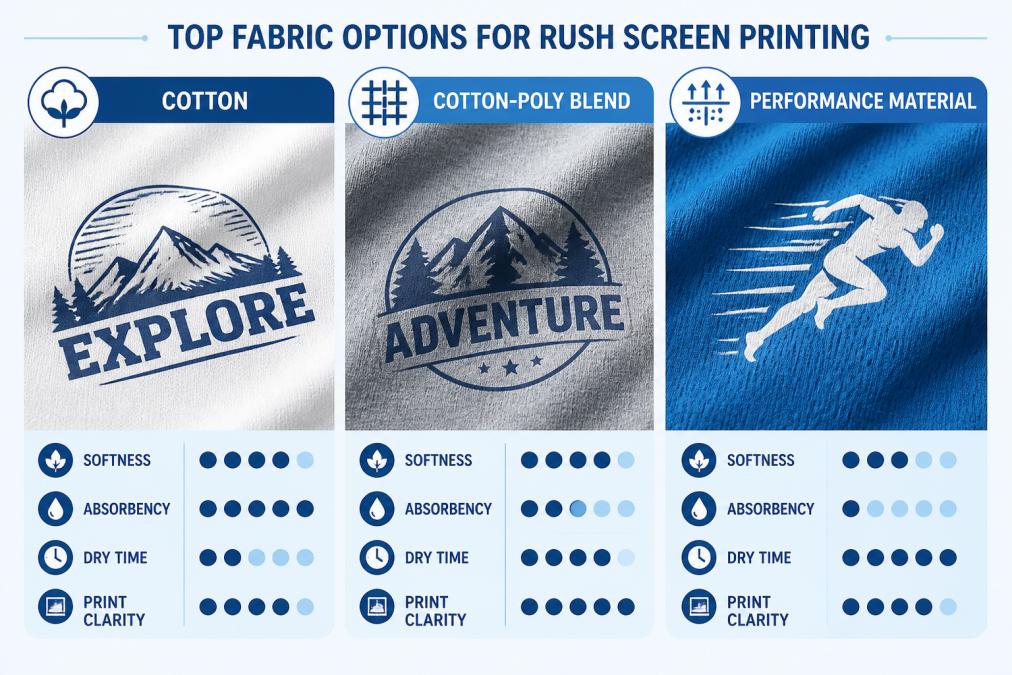
The fiber structure is naturally absorbent, so plastisol ink soaks into the material rather than sitting on the surface. This means faster cure times and better color saturation. A standard 5.3 oz cotton tee cures in 30-45 seconds with a flash unit, giving you real production speed.
Little Boys Are Superheros in Disguise →
Vireous.Shop's kids' heavy cotton tees, like the Little Boys Are Superheros in Disguise Heavy Cotton™ Kids' T-Shirt ($13.78), demonstrate the advantage of quality blanks for printing. The 100% cotton construction and midweight fabric (5.3 oz/yd²) are ideal for screen printing durability. The twill-taped shoulders and ribbed collar resist curling, which matters when you're printing at speed and the garment is moving through your press multiple times.
Best for: Standard rush orders, everyday apparel, budget-conscious customers
Pros:
- Fastest cure times (30-45 seconds)
- Widely available in bulk
- Standard plastisol ink works perfectly
- Best color saturation
Cons:
- Shrinkage on first wash (5-7%)
Cotton-Polyester Blends
Blends are the compromise fabric. They cure faster than pure polyester but not quite as fast as 100% cotton. For many rush orders, the trade-off is worth it because blends offer better durability and less shrinkage than pure cotton.
A 50/50 or 60/40 cotton-polyester blend splits the difference on cure time (45-60 seconds) while reducing shrinkage to 2-3%. This matters for customers who care about fit consistency across multiple washes. The polyester component also adds stretch and recovery, making the garment feel better against skin.
The catch: blends require slightly more heat than cotton and slightly longer flash-cure times. If your equipment is already maxed out, blends might push you over your timeline. For most mid-sized operations, though, the difference is negligible.
Inventory availability for blends is moderate. Most suppliers stock them, but not always in the full color range you need.
Pros:
- Better durability than 100% cotton
- Less shrinkage (2-3%)
- Good stretch and recovery
- Acceptable cure times for rush jobs
Cons:
- Slightly longer cure times than cotton (45-60 seconds)
- Limited color availability in some weights
- Requires careful heat control
Performance and Specialty Fabrics
Performance fabrics, moisture-wicking, UV-protective, antimicrobial, are becoming popular for athletic and outdoor apparel. But they're terrible for rush orders.
Best for: Long-lead specialty orders, not rush jobs
Pros:
- Superior durability for athletic use
- Moisture-wicking and temperature regulation
- Professional appearance
Cons:
- Cure times of 90-120 seconds
- Specialty inks required
- Limited supplier inventory
- Not viable for same-day orders
Inventory Availability and Same-Day Fulfillment
Same-day fulfillment isn't magic, it's inventory planning. You can't print what you don't have in stock.
Design Considerations for Fast Turnarounds
Design complexity doesn't directly affect speed, ink opacity does.
A simple two-color design and a complex ten-color design take the same amount of time to print if you're using the same press and flash-cure unit. What matters is the number of passes through the screen and the ink thickness per pass.
Frequently Asked Questions
Can you screen print on 100% polyester?
Yes, screen printing works on 100% polyester, but it requires different ink and curing methods than cotton. Polyester needs lower heat curing to avoid melting the fabric. Plastisol inks may not adhere as well to polyester as they do to cotton, so many printers use water-based inks or specialized polyester inks for best results. The smoother surface of polyester can actually provide excellent print quality when using the right ink compatibility approach.
What is the best fabric blend for screen printing?
Cotton-polyester blends, typically 50/50 or 65/35 cotton-to-polyester ratios, offer the best balance for screen printing. These blends combine cotton's ink acceptance with polyester's durability and shrinkage resistance. They cure faster than 100% cotton, making them ideal for rush orders. Blends also maintain color vibrancy better through multiple washes and reduce fabric pilling. For rush custom apparel printing, blends minimize the risk of ink bleeding while still providing a soft, comfortable feel.
Does screen printing work better on cotton or polyester?
Cotton generally accepts screen printing inks more readily than polyester because its natural fibers have better ink adhesion. Cotton allows plastisol inks to cure properly at standard temperatures without fabric damage. The choice depends on your turnaround deadline and end-use requirements.
Why is fabric choice important for rush printing orders?
Fabric choice directly impacts ink curing time, print quality, and inventory availability. Certain fabrics have better in-stock availability, reducing production delays. Fabric texture and weight also affect ink opacity and white underbase requirements. Choosing a fabric with proven fast-curing compatibility and reliable inventory means the difference between meeting a same-day deadline and missing it.