

Table of Contents
- Custom Apparel versus Bulk Printing: Core Differences
- Print-on-Demand versus Bulk Screen Printing: How They Work
- Minimum Order Quantity for Custom Shirts and Scalability
- Cost Analysis of Custom Apparel Production
- Quality, Turnaround Times, and Consistency
- Which Model Fits Your Creator Business
- Conclusion
Last Updated: August 21, 2026
Custom Apparel versus Bulk Printing: Core Differences
When building a creator brand, the choice between custom apparel and bulk printing shapes your cash flow, design freedom, scalability, and speed to market. At Vireous.Shop, we work with creators daily who face this exact decision.
Custom apparel (print-on-demand) produces individual items one at a time based on orders. Bulk printing manufactures large quantities upfront through screen printing or direct-to-garment methods. One model minimizes risk and maximizes flexibility; the other requires upfront capital but delivers better unit economics at scale.
The right choice depends entirely on your current stage, audience size, and risk tolerance. A creator with 5,000 followers has different constraints than one with 500,000.
| Dimension | Custom Apparel (POD) | Bulk Printing |
|---|---|---|
| Minimum Order | 1 unit | 50-500+ units |
| Cost Per Unit | Higher ($15-30) | Lower ($5-12) |
| Upfront Investment | None | $500-5,000+ |
| Turnaround Time | 3-7 days | 7-14 days |
| Design Changes | Instant | Requires reordering |
| Inventory Risk | Zero | High |
| Profit Margin | 30-50% | 60-80%+ |
| Best For | Testing, small audiences | Proven demand, scale |
Custom apparel lets you start with nothing. Bulk printing demands capital but rewards it handsomely once demand is proven.
Print-on-Demand versus Bulk Screen Printing: How They Work
Custom apparel through print-on-demand works like this: a customer orders a shirt with your design. The manufacturer prints that exact design on that exact garment, packages it, and ships it directly to the customer. You never hold inventory or pre-pay for anything.
You upload a design file, set a retail price, and the platform handles the rest. When an order comes in, the manufacturer produces and ships within a few days. Your margin is the difference between what the customer pays and what the manufacturer charges you. Vireous.Shop uses this model, leveraging OpenAI's DALL-E 3 API to let creators generate custom designs through natural language prompts, then produce them on-demand with same-day or next-day dispatch.

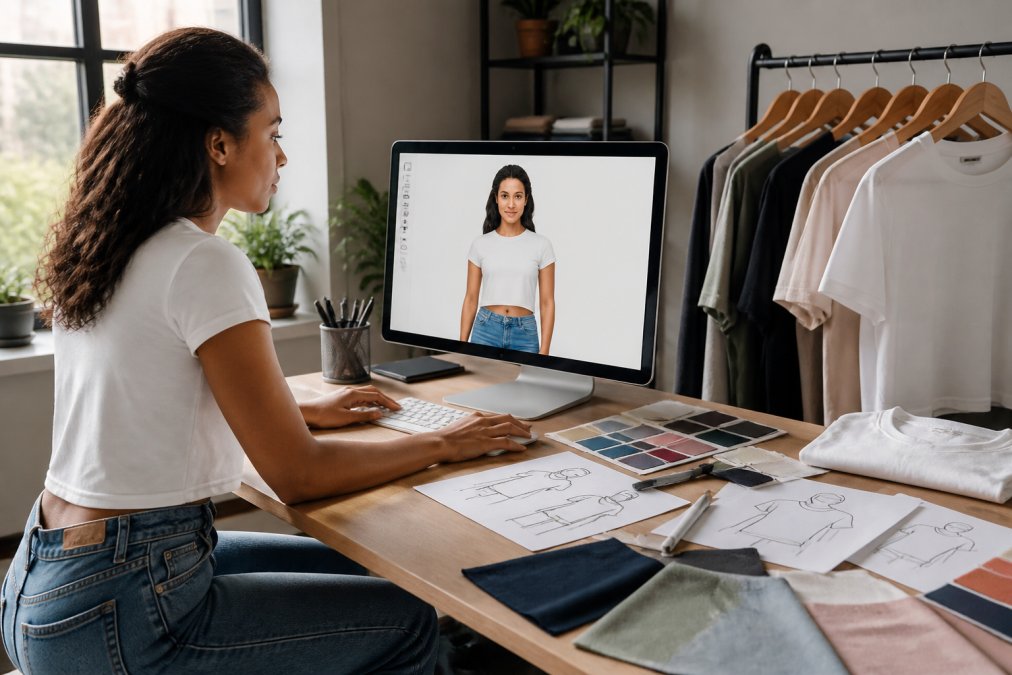
Bulk screen printing operates differently. You send your design to a manufacturer. They prepare screens, set up equipment, and produce 100, 500, or 1,000 units in one run. You receive all items at once, store them, and sell them yourself. Per-unit costs drop dramatically because setup costs are amortized across hundreds of items.
Screen printing produces superior color vibrancy and durability compared to some POD methods, especially for multi-color designs. But you're locked into that design and quantity. If it doesn't sell, you're holding deadstock.
Direct-to-garment (DTG) printing sits between these two. It's a digital method handling smaller quantities than screen printing (as few as 10 units) while maintaining better quality than some POD services. DTG works well for creators testing new designs or running limited drops, but it's slower and more expensive per unit than screen printing at true bulk volumes.
The choice hinges on one question: Do you know your design will sell? If yes, bulk printing wins on unit economics. If no, custom apparel wins on risk management.
Minimum Order Quantity for Custom Shirts and Scalability
Print-on-demand has no minimum order quantity. You can sell one shirt, one dress, or one pair of leggings.

With POD, you don't scale production, the manufacturer handles that. As your audience grows, the same system handles 10 orders or 1,000 orders without any change on your end. Your fulfillment capacity is unlimited and inventory risk remains zero.
Bulk printing requires you to predict demand accurately. A typical minimum order is 50-100 units, though some require 200 or more. This forces a decision: are you confident enough in this design to commit to 100+ units?
Here's what many creators miss: the scalability advantage flips once you reach consistent volume. If you're selling 200 units per month of a specific design, bulk printing becomes more efficient. You're producing 200 units in one batch instead of 200 separate POD orders. Lead times improve, cost per unit drops, and your profit margin expands.
For creators building a permanent product line, bulk printing's scalability advantage compounds. You're not just saving money on the current batch, you're building supplier relationships and creating operational efficiency that POD can't match.
The hybrid approach is worth considering: use POD for testing new designs, then move proven designs to bulk production. This minimizes risk while capturing efficiency gains of scale.
Cost Analysis of Custom Apparel Production
Understanding unit economics is essential. With custom apparel through print-on-demand, the financial model is transparent: you pay a fixed cost per item to the manufacturer, set your retail price, and pocket the difference.
A custom t-shirt might cost you $16-18 from the manufacturer and retail for $27.50. Your gross profit is $9-11 per unit. After platform fees (typically 5-10%) and payment processing (2.9% + $0.30), your net margin lands around 25-30%. This scales linearly with sales volume.
Bulk printing changes the equation but introduces costs most creators don't anticipate. Per-unit costs drop dramatically. A 200-unit screen-printed t-shirt order might cost $6-8 per unit, giving you $19-21 gross profit at the same $27.50 retail price. But the full picture includes:
Warehousing and storage costs. Small-scale fulfillment centers charge $0.50-$2.00 per unit per month depending on item size and location. A 200-unit inventory sitting for three months costs $300-$1,200 in storage alone.
Deadstock liquidation. If a design doesn't sell as expected, you mark it down (cutting your margin by 30-50%), donate it, or pay to dispose of it. Liquidation services typically take 40-60% of the sale price.
Capital lockup cost. When you invest $1,200-$1,600 upfront in inventory, that money isn't available for marketing or new designs. The opportunity cost of tying it up in slow-moving inventory is real.
Reorder complexity. Once you commit to bulk, you're often locked into that manufacturer's minimum order quantity for future runs. If you want to reorder a successful design, you might be forced to order 100+ units again, even if you only need 50.
Here's a concrete comparison:
POD model (100 units sold per month):
- Manufacturer cost: $16 × 100 = $1,600
- Retail revenue: $27.50 × 100 = $2,750
- Gross profit: $1,150
- Platform/payment fees (8%): −$220
- Net profit: ~$930/month
- Upfront investment: $0
- Inventory risk: $0
Bulk model (200-unit order, selling 100 units/month):
- Manufacturer cost: $8 × 200 = $1,600 (upfront)
- Retail revenue (first month): $27.50 × 100 = $2,750
- Gross profit (first month): $1,950
- Storage cost (3 months to sell through): −$300
- Payment processing (2.9% + $0.30): −$80
- Net profit (first month): ~$1,570
- But: $1,600 capital tied up, 100 units still in inventory
- Break-even point: Month 2 (after selling remaining 100 units)
The bulk model wins on margin, but only if you sell through inventory within a reasonable timeframe. If that 200-unit batch takes six months to sell, storage costs compound and your effective margin shrinks.
Bulk printing only makes financial sense if you have proven demand, ideally 2-3 months of POD sales data showing consistent interest in a design. A creator selling 15-20 custom apparel items per month through POD should stay with POD. A creator consistently moving 100+ units per month of the same design should seriously consider transitioning to bulk.
The hybrid approach addresses both models' weaknesses: use POD for design testing and new launches (zero upfront cost, zero inventory risk), then move proven bestsellers to bulk production (lower per-unit cost, higher margins). This minimizes capital at risk while capturing efficiency gains on designs you know will sell.
Quality, Turnaround Times, and Consistency
Quality and turnaround time are tied to the production method you choose, and each method has specific technical requirements that directly affect the final product.
Print-on-demand quality and file requirements:
Modern POD services use direct-to-garment (DTG) printing or heat-transfer methods. DTG printers inject ink directly onto fabric, producing photorealistic results with unlimited colors (peer-reviewed research). This works beautifully for photographic designs, gradients, and complex artwork. However, DTG works best on 100% cotton or cotton-blend garments and can fade faster than screen printing if washed frequently in hot water.
For POD, your artwork file should be RGB color mode (not CMYK), 300 DPI minimum, placed within the safe print zone (typically 0.5 inches from garment edges), and free of very fine details under 2 points (peer-reviewed research).
Turnaround time for POD is typically 3-7 days from order to shipment. Quality consistency depends on the POD provider's equipment maintenance and quality-control processes. The best providers produce results indistinguishable from small-batch screen printing.
Screen printing quality and file requirements:
Screen printing produces vibrant, durable color and a smooth hand-feel (peer-reviewed research). It excels at solid colors and bold designs with 1-4 colors and is the industry standard for bulk apparel because per-unit cost drops dramatically as volume increases.
For screen printing, your artwork file should be separated into individual color layers (one layer per screen), submitted as vector artwork (AI, EPS, or PDF) or high-resolution raster (300 DPI minimum), limited to 4-6 colors for cost efficiency, and submitted in CMYK color mode.
Screen printing turnaround is typically 7-14 days for production, plus shipping. Quality is exceptionally consistent because all items in a batch go through the same screens and settings.
Direct-to-garment (DTG) printing:
DTG sits between POD and screen printing. It can handle smaller quantities than screen printing (as few as 10 units) while maintaining better durability than some POD services. DTG turnaround is typically 5-10 days and is ideal for creators testing designs or running limited drops (25-100 units).
Consistency across production runs:
Screen printing produces exceptional consistency within a batch. But consistency across batches can vary if the manufacturer changes ink suppliers, fabric sources, or equipment. POD consistency depends on equipment maintenance. If the DTG printer is well-calibrated and regularly serviced, consistency is excellent.
Practical quality checklist:
Before committing to any production method:
-
Request samples. Order a sample using your actual artwork file. Inspect color accuracy, print durability (wash it), and hand-feel.
-
Verify file specifications. Confirm your artwork meets the manufacturer's requirements before submitting a large order.
-
Test durability. For screen printing and DTG, wash the sample in hot water multiple times. Check for fading, cracking, or peeling.
-
Check color accuracy. Bring a Pantone swatch or reference image to your manufacturer. Screen printing can match Pantone colors precisely; POD and DTG are close but not always exact.
-
Inspect registration (for multi-color designs). Ensure colors align properly. Misalignment looks unprofessional.
For creators building a brand, consistency is critical. Screen printing offers the best consistency within a batch but requires bulk commitment. POD offers good consistency if you choose a quality provider, with zero inventory risk. The hybrid model addresses this: produce your best-selling designs in bulk (screen printing) for consistency and cost efficiency. Use POD for new designs, limited editions, and seasonal items.
Which Model Fits Your Creator Business
The decision depends on three factors: your current audience size, your risk tolerance, and your growth timeline.
If you have fewer than 10,000 engaged followers, custom apparel through POD is almost certainly the right choice. Your audience is too small to absorb a 100-unit minimum order. You don't have enough historical data to predict what will sell. Use this phase to test designs, build brand recognition, and gather data on what your audience actually wants to buy.
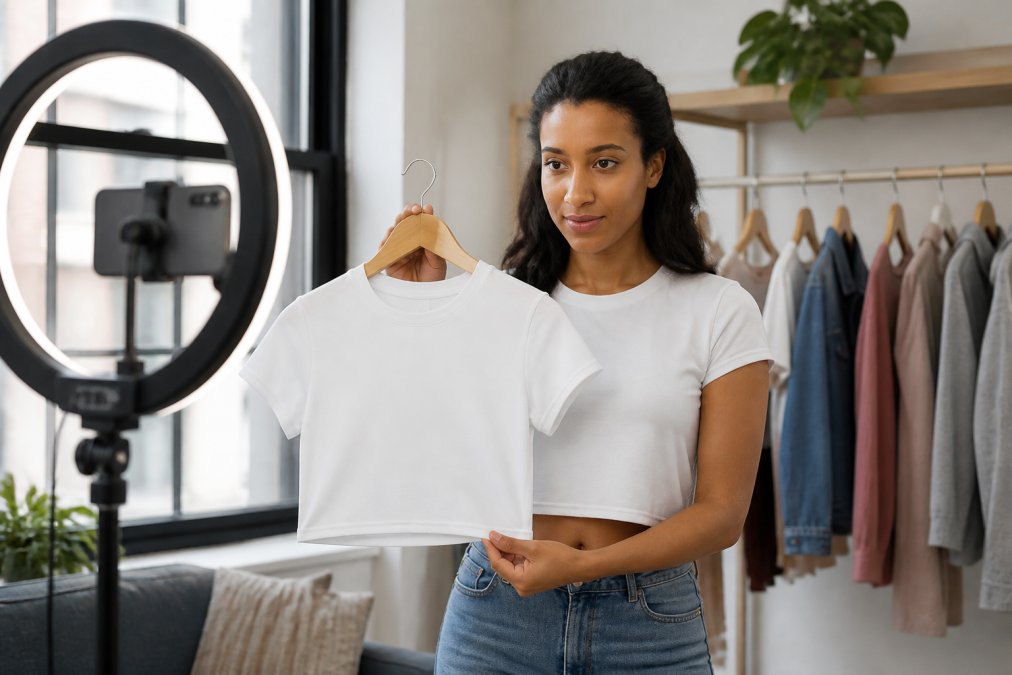
If you have 10,000-50,000 followers with consistent engagement, you're in the transition zone. Run POD sales for 2-3 months. Track which designs sell best. Once you have clear winners, designs that consistently move 50+ units per month, transition those to bulk production. Keep testing new designs through POD. This hybrid approach lets you capture margin improvements on proven designs while minimizing risk on new ones.
If you have 50,000+ followers and a track record of successful merchandise sales, bulk printing becomes attractive. Your audience is large enough to absorb inventory. You have historical data showing what sells. The margin improvement justifies the upfront investment.
Vireous.Shop's platform is built for creators in the POD phase. The AI-powered design generation through DALL-E 3 integration lets you create unlimited unique designs without hiring a designer or buying expensive design software. Same-day or next-day dispatch means your customers get products fast. The Money Back Guarantee protects both you and your customers. This setup minimizes friction and risk, letting you focus on building your audience and testing what resonates.

Frequently Asked Questions
What is the difference between custom apparel and bulk printing?
Custom apparel (print-on-demand) produces items individually as orders arrive, with no minimum order quantity. Bulk printing requires ordering large quantities upfront, typically 50-500+ units, at a lower per-unit cost. Custom apparel offers design flexibility and zero inventory risk; bulk printing offers better unit economics and brand consistency for high-volume sellers. Choose custom apparel if you're testing designs or have unpredictable demand; choose if you've validated demand and can forecast inventory needs.
Is print-on-demand more cost-effective than bulk ordering?
For small orders and first-time designs, print-on-demand is more cost-effective because you avoid upfront capital expenditure and deadstock risk. A custom crop tee from Vireous.Shop costs $27.50 per unit with same-day or next-day dispatch. Bulk screen printing offers lower per-unit costs but requires minimum order quantities of 50-100+ units, creating fixed costs and inventory management overhead. Print-on-demand wins for testing; bulk wins once you've proven demand.
How do I decide between custom apparel and bulk inventory?
Start with custom apparel if you're a new creator with limited followers or unproven designs. Use it to test audience response, refine your brand aesthetic, and build initial social proof. Switch to bulk printing once you have consistent demand: reliable monthly sales data, customer feedback validating your designs, and sufficient capital to invest in 100+ unit minimums. A hybrid approach works too, use custom apparel for limited editions and experimental designs while bulk printing your bestsellers for better profit margins.
What are the quality differences between screen printing and digital printing?
Screen printing uses separate screens for each color, producing vibrant, durable results ideal for solid designs and large orders. Digital printing (including direct-to-garment and all-over printing) applies designs directly to fabric, supporting unlimited colors and photorealistic detail. Vireous.Shop uses all-over digital printing for custom apparel, allowing intricate designs from AI-generated artwork on items like our crossover leggings ($43.50) and midi dress ($46.00). Digital printing excels for personalization; screen printing excels for bold, simple brand logos on bulk orders.
Does bulk printing require a minimum order quantity?
Yes. Bulk screen printing typically requires minimums of 50-500 units per design, depending on the printer and complexity. Digital bulk printing may have lower minimums (25-50 units). These minimums exist because setup costs (screens, color separation, machine time) are spread across the order. Custom apparel has no minimum, you order one piece at a time. For creators with 5K followers testing merchandise, custom apparel eliminates the financial risk of unsold inventory while you validate demand.
The real answer to custom apparel vs bulk printing isn't "one is better." It's "one is better for your current situation." Start with custom apparel. Build audience and validate designs. Graduate to bulk printing once you've proven demand. Most successful creator brands use both, POD for experimentation and bulk for scale. Your job is knowing which phase you're in and choosing accordingly.
This article was written using GrandRanker