

Table of Contents
- Start With Your Sofa, Not the Wall
- Wall Art Above Sofa Size: Getting the Proportions Right
- How to Hang Large Canvas Art Without Damaging Your Wall
- One Large Canvas or Multiple Panels? How to Decide
- Living Room Canvas Art Ideas That Match Your Room
- Common Sizing and Placement Mistakes to Avoid
- Frequently Asked Questions
Last Updated: October 18, 2026
Start With Your Sofa, Not the Wall
The fastest way to get oversized canvas art wrong is to measure the wall first. Measure the sofa instead.
Oversized canvas art is a large-scale print, typically the single biggest piece on a living room wall, sized to relate to the furniture below it rather than to the wall alone. The wall is just the backdrop.
Art should look anchored to the seating area, not dropped from the ceiling. Get that relationship right and the room reads as designed; get it wrong and even beautiful artwork feels off.
The 60-75% Furniture-Width Guideline
The most reliable starting point is simple: your canvas should span roughly 60% to 75% of the sofa's width. A standard 84-inch sofa points you toward art somewhere between about 50 and 63 inches wide.
Narrower than 60% and the art looks stranded; wider than 75% and it overwhelms the furniture and crowds the wall.
- Small loveseat (around 60 inches): aim for a canvas 36 to 45 inches wide
- Standard sofa (around 84 inches): aim for 50 to 63 inches wide
- Large sectional (around 120 inches): aim for 72 to 90 inches wide, or split into panels
Measure the sofa back, not the cushions. That's the visual line the art sits above.
What Size Canvas for Living Room Layouts
The right canvas size depends on the layout, not just the sofa. Three setups cover most homes:
- Single sofa against one wall: one large horizontal canvas at 60-75% of the sofa width
- Open-concept home: a bigger piece, because the art competes with more visual space
- Sectional or corner seating: a wide horizontal canvas or a multi-panel set that follows the seating line
In open-concept rooms, wall span matters as much as the sofa: a canvas that looks generous in a closed room can look small once it shares sightlines with a kitchen or hallway.
Wall Art Above Sofa Size: Getting the Proportions Right
Wall art above a sofa size comes down to two numbers: width and the gap. For width, use the 60-75% furniture-width guideline.
That gap is where most people slip. Too high and the art disconnects from the furniture.
The bottom edge should feel like it belongs to the sofa group. Think of the sofa, the art, and the space between them as one visual unit.
Ceiling Height and Vertical Balance
High ceilings change the math: a single canvas hung at sofa height can leave a large empty band above it, which is where vertical balance comes in.
A few ways to handle ceiling height:
- Standard 8-foot ceiling: a single canvas centered above the sofa works well
- 9 to 10 feet: go taller with the canvas, or add a second smaller piece above
- Very high ceilings: stack two works or choose a tall vertical canvas to pull the eye up
The goal is visual balance, not filling every inch. A little breathing room above the art is fine. A cavern of bare wall is not.
How to Hang Large Canvas Art Without Damaging Your Wall
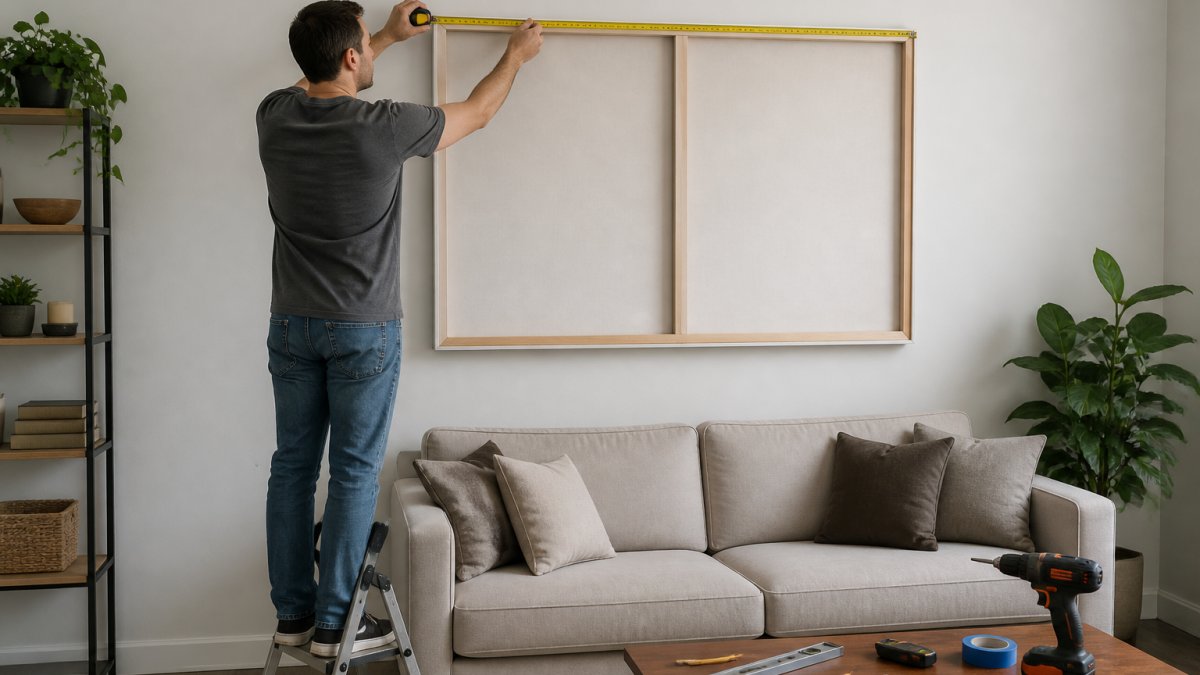
Hanging a large canvas is a measuring job first and a drilling job second.
- Mark the centerline. Measure the sofa's width and mark its center on the wall with a pencil. If the sofa isn't centered on the wall, center the art on the sofa, not the wall, the art belongs to the seating group.
- Set the height. Mark where the bottom edge should sit, about 6 to 10 inches above the sofa back. Use painter's tape to mark the full bottom line so you can step back and check it.
- Find the hanging point. Measure from the top of the canvas down to the sawtooth hanger or wire, then transfer that distance down from your top-edge mark. If the canvas uses a wire, pull the wire taut at the center and measure to the peak, the wire stretches under weight, so add about an inch of slack.
- Check level. Use a spirit level to draw a faint line before you drill. For a canvas wider than about 48 inches, mark both hanging points and level between them, not just at the center.
- Anchor properly. Drill pilot holes and use the right hardware for your wall type. Hold the canvas up to the wall and mark the hanger positions through the hardware itself rather than eyeballing.
- Hang and adjust. Set the canvas, step back, and confirm it's level and centered. Small adhesive felt pads on the bottom corners keep a large canvas from rocking against the wall.
Most Vireous.Shop canvases ship with a hanging kit that includes two screws and a sawtooth hanger, so you have the basics in the box.
Wall Type, Hardware, and Canvas Weight
The hardware you need depends on what's behind the drywall, the step people skip, and the one that decides whether the canvas stays up.
Man Entering Portal, Abstract, Large Canvas Art Print →
- Drywall with wood studs: drive screws into the studs where possible for the strongest hold. Studs are typically spaced 16 inches on center, though older homes can be 24 inches, so use a stud finder rather than tapping.
- Drywall without studs: use self-drilling drywall anchors rated for the canvas weight. Threaded anchors hold far better than the push-in plastic sleeves that come with cheap kits.
- Plaster or brick: use masonry anchors and a drill bit made for the material. Plaster cracks easily, so drill slowly and avoid hammering near the edge of a wall.
A large stretched canvas is light for its size, but weight adds up fast as dimensions grow: a 60-inch canvas can weigh noticeably more than a 24-inch piece once the frame and stretcher bars are counted.
One Large Canvas or Multiple Panels? How to Decide
A single large canvas is the safer choice for most living rooms: easier to center, easier to hang level, and it reads as a clean focal point. It's our default recommendation when the sofa is the main anchor.
Multi-panel artwork, sometimes called a split canvas, earns its place in specific situations:
- Very wide walls where one canvas would need to be enormous
- Open-concept spaces where a row of panels carries the eye across the room
- Design preferences for a gallery-style, modern look
The trade-off is fussiness: panels must be spaced evenly and hung at the same height, and any drift shows. Want simple? Go single. Want a statement across a big wall? Panels work.
| Layout | Best For | Watch Out For |
|---|---|---|
| Single large canvas | Most living rooms, sofa-anchored walls | Can look small on very wide walls |
| Two or three panels | Wide or open-concept walls | Spacing and leveling take care |
| Gallery cluster | Eclectic, collected look | Hardest to balance and hang |
Living Room Canvas Art Ideas That Match Your Room
The best living room canvas art ideas start with the room you already have, not the art you wish you had.
A simple decision framework covers most rooms:
- Start with the dominant color. Pull the two or three colors that already repeat in the room, sofa, rug, curtains, throw pillows. Art that echoes one of them ties the room together; art that introduces a fourth strong color competes with everything.
- Decide contrast on purpose. In a calm, neutral room, a bold abstract adds energy. In a busy room with pattern on the rug and pillows, a soft tonal abstract calms things down. High-contrast art in a high-contrast room reads as chaos.
- Match the subject to the furniture style. Geometric and structured art complements modern, low-profile furniture. Painterly or organic abstracts sit more comfortably with traditional or transitional pieces.
A few directions that work in most homes:
- Bold abstract pieces to add energy to a neutral room
- Soft, tonal abstracts to calm a busy room
- Geometric or structured art to complement modern furniture
This is where custom art earns its keep. Our Man Entering Portal abstract canvas is a good example of a bold piece built to anchor a seating area, and it comes in 24 sizes with horizontal, vertical, and square options to fit your wall.


Lighting, Glare, and Viewing Distance
Lighting decides whether your canvas looks rich or washed out, and it changes which imagery works. A few rules:
- Avoid direct sun on glossy or brightly colored prints, which fades over time. If the wall gets strong afternoon light, choose a matte finish and consider UV-filtering glazing or a sheer curtain.
- Use soft, angled light from a floor lamp or wall sconce to bring out color. Light raking across the canvas from the side emphasizes texture; light straight on flattens it.
- Check glare from windows and TV screens at the height you plan to hang. Stand where you'll actually sit and look at the wall, glare you can't see from the doorway can be obvious from the sofa.
If a window throws hard light across the wall, angle the art or add a sheer curtain to protect the print and keep colors true. If the canvas hangs opposite a television, check that a bright image doesn't compete with the screen, a tonal or low-contrast piece is easier to live with in a media room.
Common Sizing and Placement Mistakes to Avoid
Most oversized canvas art problems trace back to a handful of repeat mistakes:
- Buying for the wall, not the sofa. The furniture sets the scale.
- Going too small. Under 60% of the sofa width looks timid.
- Hanging too high. Keep the bottom edge 6 to 10 inches above the sofa.
Get these right and the rest is easy. The canvas dimensions, the gap, and the hardware do most of the work.
Choosing oversized canvas art for a living room is a measuring exercise wrapped in a design decision, and most people start with the picture and work backward, exactly how scale goes wrong. At Vireous.Shop, we make the design side simple: generate a custom canvas from a natural-language prompt, pick from 24 sizes to match your sofa width, and get same-day or next-day dispatch on personalized items, all backed by our Money Back Guarantee.
Frequently Asked Questions
What is a good size canvas for a living room?
A good size depends on the furniture below it. Measure your sofa's width, then aim for a canvas that covers roughly 60-75% of that span. For a standard 84-inch sofa, that means a canvas about 50 to 63 inches wide. If the wall is expansive and mostly empty, you can go larger. The goal is a canvas that feels connected to the seating area rather than floating alone on a big wall.
How high should you hang oversized canvas art?
The center of the canvas should sit at eye level, roughly 57 to 60 inches from the floor. When hanging above a sofa, leave 6 to 10 inches of space between the top of the sofa back and the bottom of the frame. In rooms with high ceilings, you can raise the art slightly, but keep it visually tied to the furniture below so it doesn't drift toward the ceiling.
Can oversized canvas art make a small living room look bigger?
Yes, when it's scaled correctly. A single large canvas can make a small room feel more intentional and draw the eye upward, which adds a sense of height. The risk is going too large for the available wall span. Measure your wall and furniture first, then choose a canvas that fills 60-75% of the furniture width. A canvas that overwhelms the wall will make the room feel cramped instead.
How do you choose between one large canvas and a gallery wall?
Choose one large canvas when you want a clean focal point and your wall is relatively uncluttered. A single oversized piece works well above a sofa and in open-concept rooms. Choose a multi-panel or gallery arrangement when you want to fill a wider wall or mix different images. Keep in mind that multiple panels need consistent spacing, usually 2 to 3 inches between frames, and a shared color palette to look cohesive.