

Table of Contents
- Start With the Design, Not the Method
- Custom Apparel Printing Methods at a Glance
- Screen Printing vs. Direct-to-Garment Printing
- Embroidery vs. Printing on Clothing
- Matching the Personalization Technique to Your Order Size
- The Best Printing Method for Custom Shirts by Use Case
- How Fabric and Color Change Your Personalization Technique
- Conclusion
- Frequently Asked Questions
Last Updated: October 17, 2026
Start With the Design, Not the Method
Most people pick a printing method first, then try to force their design into it. That's backwards. The right way to choose a personalization technique is to lock your artwork first, then find the method that reproduces it faithfully at your order size and budget.
This guide from Vireous.Shop walks you through that decision in order. We'll cover the main custom apparel printing methods, the real trade-offs between screen printing and direct-to-garment, and how fabric and color change the answer. By the end, you'll know exactly which technique fits your project.
A personalization technique is the specific process used to transfer a custom design onto a garment or product, such as screen printing, direct-to-garment, or embroidery. Each one handles detail, color, and texture differently.
Here's the part most guides skip: your design's complexity decides more than your budget does. A photo with hundreds of colors and a two-color logo need completely different methods.
Custom Apparel Printing Methods at a Glance
At Vireous.Shop, we offer direct-to-garment (DTG) printing for custom apparel. This method excels in different situations.
- Direct-to-garment: Best for detailed, full-color artwork and small batches
The U.S. Small Business Administration guide to choosing a manufacturer is a useful starting point if you're sourcing production for the first time.
Use this table to match your project to a method before reading further:
| Method | Best For | Detail Level | Small Runs |
|---|---|---|---|
| Screen printing | Bold logos, bulk orders | Medium | No |
| Direct-to-garment | Photos, gradients, small batches | High | Yes |
| Embroidery | Logos, polos, premium merch | Medium | Yes |
| Heat transfer vinyl | Names, numbers, one-offs | Low | Yes |
Screen Printing vs. Direct-to-Garment Printing
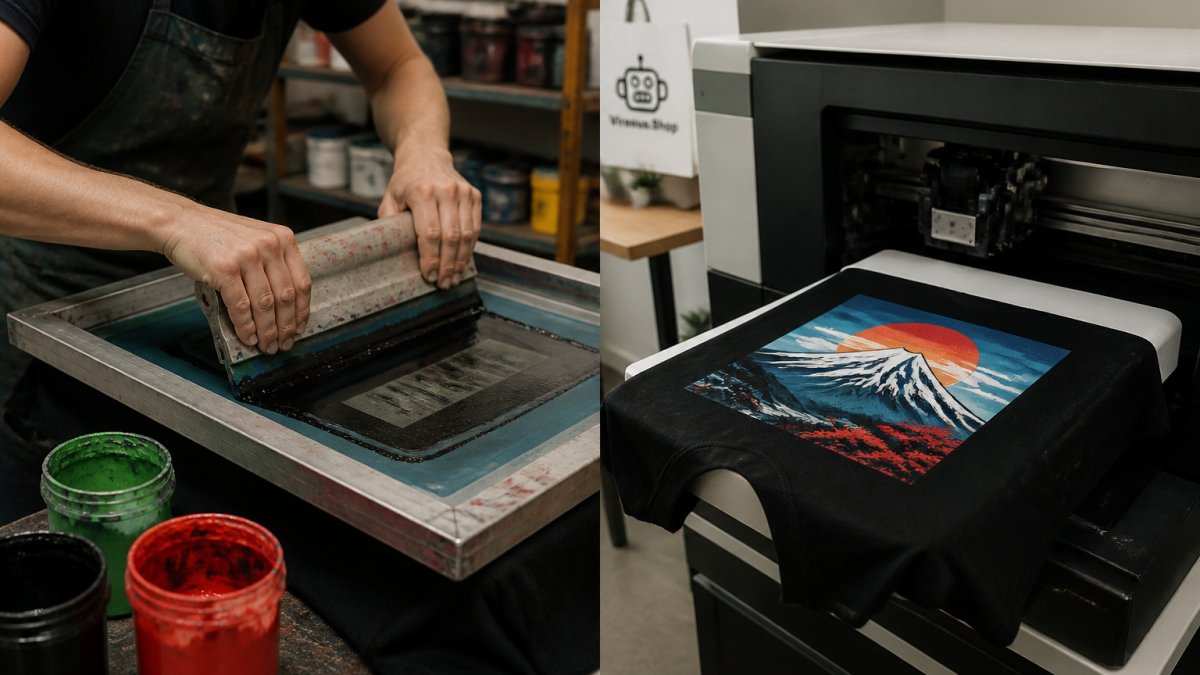
Direct-to-garment printing sprays water-based ink straight onto the fabric, like a desktop printer for shirts.
DTG handles photographic detail and unlimited colors with no setup, which suits creators ordering a handful of pieces.
Embroidery vs. Printing on Clothing
Printing lays ink on top. Choose printing when your design has fine detail, gradients, or lots of colors.
Printing wins when your design has fine detail, gradients, or lots of colors.
- Choose printing for: photos, complex art, large graphics, budget merch
The Federal Trade Commission guidance on textile labeling explains what fiber and care information must appear on apparel, which matters when you're sourcing blanks.
Matching the Personalization Technique to Your Order Size
Order size narrows your options fast. Small batches favor DTG.
Here's the rule we'd use:
Mars and Venus as Robots in the Style Of Botticelli 'Designed by AI' Wooden →
- 1 to 50 pieces: DTG, depending on design
If you're a small creator testing merch with a few hundred followers, DTG lets you order a small batch without setup fees. Vireous.Shop's made-to-order model fits that workflow, since you can generate a design with a natural language prompt and order it without holding inventory.
The Best Printing Method for Custom Shirts by Use Case
The best printing method for custom shirts depends on the job. There's no universal winner, only the right fit for your use case.
Match your project here:
| Use Case | Best Method | Why |
|---|---|---|
| Brand merch for followers | DTG | Small runs, full color, no setup |
| Team uniforms | Embroidery | Durable, professional texture |
| Event giveaways | Screen printing | Cheap at volume |
| One-off gifts | Heat transfer vinyl | Fast, low minimum |
| Photo-based art | DTG | Handles gradients and detail |
For creators building a personal brand, DTG is usually the safest first choice. It handles the AI-generated artwork that tools like OpenAI's DALL-E documentation describe, with rich color and fine detail.
How Fabric and Color Change Your Personalization Technique
Fabric and color can override your method choice. Cotton takes DTG ink beautifully, while polyester blends can shift the color. Dark fabrics need a white ink base for DTG, which adds texture.
- 100% cotton: great for DTG
- Polyester blends: test first, colors can shift
- Dark colors: expect a white underbase for DTG
If you're also ordering wall art to match a brand launch, the Mars and Venus as Robots in the Style Of Botticelli 'Designed by AI' Wooden Framed Print uses the same AI design workflow, printed on FSC-certified paper with a hand-crafted wooden frame.

Conclusion
Choosing a personalization technique comes down to four questions: how detailed is your design, how many pieces do you need, what fabric are you printing on, and what look do you want. Answer those and the method picks itself.
At Vireous.Shop, we built our made-to-order platform around that flexibility. You can generate a design from a natural language prompt, preview it before ordering, and get same-day or next-day dispatch on personalized items, all backed by our Money Back Guarantee.
Ready to turn your idea into wearable art? Customize your design with Vireous.Shop and order with confidence.
Frequently Asked Questions
How do I choose a personalization technique for custom apparel?
Start with your design's complexity, then your order size and fabric. Detailed, multicolor artwork with small runs points to direct-to-garment printing. Match the personalization technique to what the design actually needs, not to what a supplier happens to offer.
What is the difference between screen printing and direct-to-garment printing?
Direct-to-garment printing sprays ink directly onto the fabric like a printer, so there is no setup fee and full-color designs are practical on small batches. DTG suits detailed, low-volume work.
Is embroidery or printing better for personalized clothing?
Printing handles gradients, photos, and fine detail that thread cannot reproduce. If it is a full-color illustration, printing wins.
Which apparel personalization method works best for detailed designs?
Direct-to-garment printing handles detailed, multicolor artwork best because it lays down full-color ink without per-color setup. For intricate art, DTG is the practical pick.