

Table of Contents
- What a Quality Guarantee for Custom Prints Actually Covers
- Reprint vs. Refund Policy for Custom Apparel: How to Choose
- File Resolution Requirements for High Quality Prints
- How to Ensure High Quality Custom Prints Before You Order
- Screen Printing vs. DTG Longevity: Which Holds Up Longer
- Exclusions, Limitations, and What the Quality Guarantee for Custom Prints Does Not Cover
- Print Durability Testing and Eco-Friendly Ink Standards
- Conclusion
Last Updated: August 3, 2026
A quality guarantee for custom prints is a formal commitment that your finished product will match the approved design, meet defined workmanship standards, and arrive free of production defects. The gap between a vague "satisfaction guarantee" and a clearly defined reprint policy is enormous. Below, we'll show you exactly what a credible guarantee covers, how to file a claim, and what you can do before you order to make returns unnecessary.
The real value is in the technical standards behind it: color accuracy tolerances, ink adhesion requirements, fabric quality benchmarks, and file resolution thresholds. Understand those standards, and you'll rarely need to invoke the guarantee at all.
What a Quality Guarantee for Custom Prints Actually Covers
A quality guarantee covers production-side failures: misprints, color deviations from the approved proof, defects in workmanship, and material integrity issues that originate in manufacturing. It does not cover design decisions the customer approved before printing began.
When a guarantee claim is denied, it's almost always because the issue traces back to customer-approved artwork or a customer-selected product specification, not a production error.
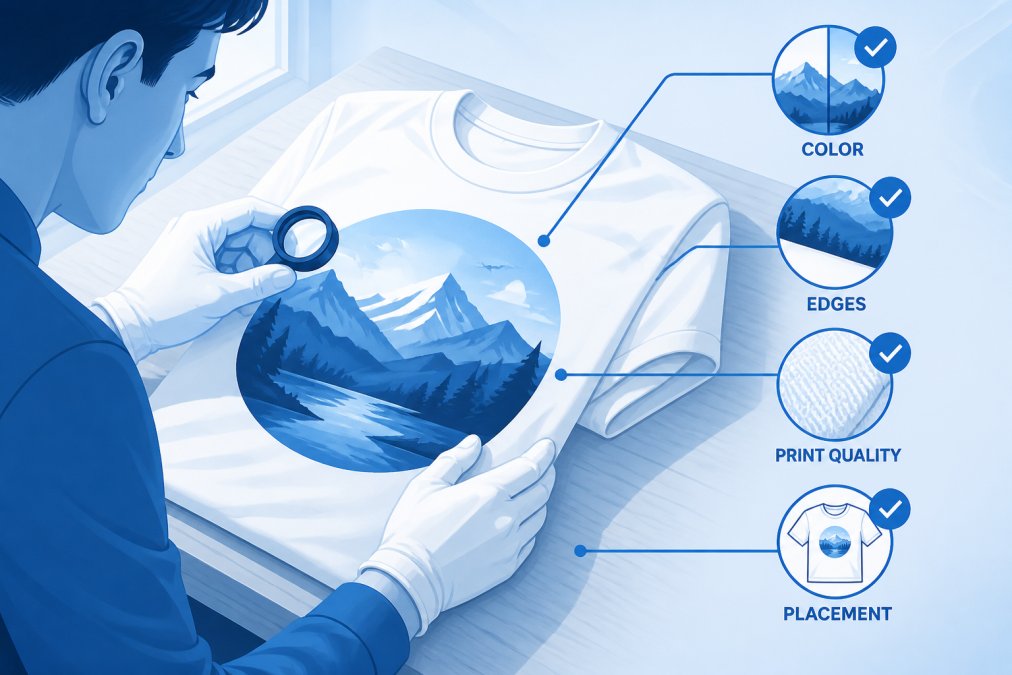
Production Errors vs. Customer-Side Mistakes
Production errors are failures the print facility introduced: a misregistered screen, an inkjet head clog, a garment cut from the wrong fabric weight, or a canvas stretched unevenly. These are covered.
Customer-side mistakes are excluded. If you approved a low-resolution proof, chose a garment color that mutes the print, or submitted artwork with incorrect bleed settings, the printer executed your instructions correctly. Common exclusions include artwork submitted below minimum resolution, color expectations based on uncalibrated monitors, spelling errors in approved files, and size discrepancies from incorrect template selection.
Material Integrity and Workmanship Standards
Material integrity covers the physical substrate: fabric weight, fiber composition, archival-grade materials, and ink wash-fastness standards. Workmanship standards address execution: seams, hems, print registration, and ink adhesion to substrate. A print that peels after one wash failed a workmanship standard.
According to the American Apparel & Footwear Association's quality benchmarks, consistent material specifications are the foundation of any defensible print quality assurance program.
Reprint vs. Refund Policy for Custom Apparel: How to Choose
The reprint vs. refund decision depends on timeline, intended use, and the nature of the defect. A reprint makes sense when the event is still upcoming and the defect is clearly a production error. A full refund is appropriate when the timeline has passed, the quantity is small, or the defect pattern suggests a systemic issue.
Most print providers default to reprints because custom apparel cannot be restocked. A no-risk policy should give the customer meaningful choice.
Timeline for Submitting a Guarantee Claim
Most providers require claims within 7 to 30 days of delivery. Check the specific window before accepting delivery and set a calendar reminder.
The practical steps for a timely claim:
- Photograph every defective item against a neutral background within 48 hours of delivery
- Document the defect type: color shift, print placement error, ink adhesion failure, or material defect
- Cross-reference your approved proof against the delivered product
- Submit via the provider's designated contact channel with order number, defect photos, and written description
- Request written confirmation of receipt and an estimated resolution timeline
Delay is the most common reason valid claims are denied.
Customer Support and Contact Procedures
A provider's contact procedures reveal how seriously they take quality assurance commitments. Look for a dedicated support channel for defect claims, a named escalation path, and a written response SLA.
When contacting support, include your order number, delivery date, clear photographs showing the defect in natural light, a brief description of expected versus received outcome, and whether you need a replacement or refund.
File Resolution Requirements for High Quality Prints
File resolution requirements are non-negotiable. The standard minimum for print-ready artwork is 300 DPI at the final print size. Submitting a 72 DPI web image scaled up produces pixelation that no production process can correct.
Vector files scale without quality loss and are the gold standard for custom apparel and wall art. According to the Printing Industries of America's technical guidelines, artwork resolution errors account for a significant share of print defects incorrectly attributed to production failures.
Troubleshooting Common File Preparation Errors
Resolution errors: Upscaling a low-resolution image in Photoshop does not add pixel data. Always start from a high-resolution source file.
Color mode errors: RGB files shift noticeably when converted to CMYK for print. Design in CMYK from the start, or request a color proof before approving a large run.
Bleed and safe zone errors: Artwork extending to the edge needs bleed area beyond the trim line. Artwork that must not be cut needs to stay inside the safe zone.
Font errors: Unembedded fonts render as default substitutes. Convert all text to outlines before submitting.
| File Error | What It Looks Like | Fix |
|---|---|---|
| Low resolution | Pixelated, blurry edges | Use 300 DPI source at final print size |
| RGB color mode | Unexpected color shift in print | Design in CMYK; request a color proof |
| Missing bleed | White edges, misaligned crop | Add 0.125" bleed beyond trim line |
| Unembedded fonts | Wrong typeface in final print | Convert all text to outlines before export |
| Incorrect file format | Compression artifacts visible | Submit PDF, AI, or high-res TIFF |
How to Ensure High Quality Custom Prints Before You Order
The best way to ensure high quality is to front-load quality control before the job enters production. Fixing a file costs nothing. Reprinting costs time, money, and goodwill.
Here's a pre-order checklist:
- Artwork is 300 DPI minimum at final print dimensions
- Color mode is CMYK (or a proof has been requested for RGB-to-CMYK conversion)
- All fonts are converted to outlines or embedded
- Bleed and safe zones match the provider's template specifications
- File format is PDF, AI, EPS, or high-resolution TIFF
- A physical or digital proof has been approved before production begins
- Garment color and fabric weight have been confirmed against the design palette
- Order verification details have been reviewed
Proof approval is the single most important step. A signed-off proof creates a shared reference point. If the delivered product deviates from the approved proof, the claim is straightforward.
Vireous.Shop's AI-powered design workflow generates artwork from natural language prompts using DALL-E 3 technology, allowing you to see the output before it goes to production, which substantially reduces the gap between expectation and delivery.
Screen Printing vs. DTG Longevity: Which Holds Up Longer
Screen printing outlasts direct-to-garment printing in most wash durability tests, but the margin depends on ink quality, pre-treatment process, and fabric composition.
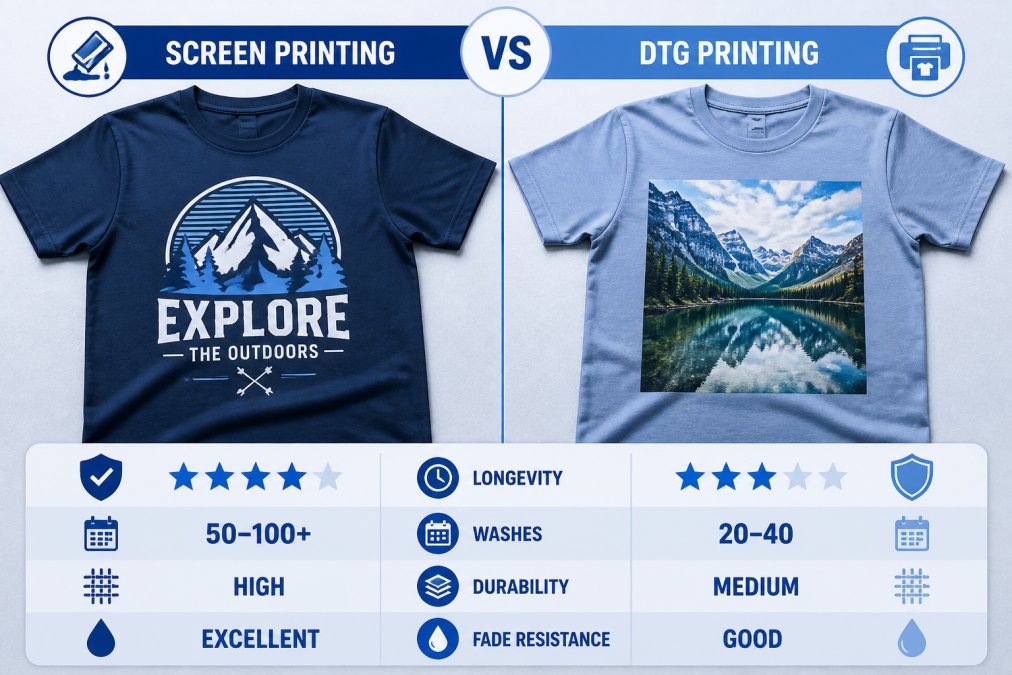
Screen printing deposits a thicker ink layer that bonds mechanically to fabric. Properly cured plastisol inks on cotton garments routinely survive 50 or more wash cycles without significant fade. The limitation is color count: each color requires a separate screen, making photographic designs expensive.
Direct-to-garment printing uses water-based inks jetted directly onto pre-treated fabric. The color range is unlimited, making it ideal for photographic and AI-generated designs with complex gradients. DTG prints require cold-water washing and inside-out washing to achieve comparable longevity to screen printing.
| Factor | Screen Printing | Direct-to-Garment |
|---|---|---|
| Wash durability | Very high (50+ washes) | Moderate (requires care) |
| Color complexity | Limited (cost per color) | Unlimited |
| Best fabric | 100% cotton | Pre-treated cotton blends |
| Minimum order | Typically higher | Single unit viable |
| Detail resolution | Lower | High (photographic quality) |
| Eco-friendly inks | Available (water-based) | Standard (water-based) |
For branded merchandise with a simple logo, screen printing delivers superior longevity. For personalized items with photographic AI-generated artwork, DTG is appropriate and longevity is managed through wash instructions.
Exclusions, Limitations, and What the Quality Guarantee for Custom Prints Does Not Cover
Standard exclusions across most print providers include approved artwork errors, color variation within tolerance, wear and tear after normal use, sizing dissatisfaction, and third-party damage after shipment.
Product liability for custom apparel in the United States is governed by the Consumer Product Safety Improvement Act. According to the Federal Trade Commission's consumer protection guidelines, sellers must clearly disclose material limitations on satisfaction guarantees.
Print Durability Testing and Eco-Friendly Ink Standards
Print durability testing evaluates how well ink adhesion, color fastness, and substrate integrity hold up under simulated use conditions. The primary testing standards are AATCC (American Association of Textile Chemists and Colorists) protocols, which test wash-fastness, crocking resistance, and light fastness.
A rating of 4 or 5 on the AATCC grey scale indicates excellent retention. Most commercial screen printing inks achieve this on 100% cotton. DTG inks on properly pre-treated garments reach similar ratings when care instructions are followed.
Water-based inks, standard in DTG printing, carry lower environmental impact than traditional plastisol inks because they don't contain PVC or phthalates. Look for providers using inks certified under OEKO-TEX Standard 100, which tests for harmful substances at each production stage. According to the OEKO-TEX Association's certification standards, this certification covers every component of a finished textile product.
The combination of water-based inks, OEKO-TEX certified substrates, and documented wash-fastness testing represents current best practice in print durability assurance.
Custom printing involves more variables than most buyers anticipate, and a vague satisfaction guarantee doesn't protect you when those variables produce an unexpected result. The solution is a provider that defines quality standards technically, supports claims with a clear reprint or refund process, and gives you the tools to prepare print-ready files before production begins. Vireous.Shop combines AI-powered design generation through DALL-E 3 with same-day or next-day dispatch on personalized items, so the gap between your creative vision and the finished product stays as small as possible. Customize your next print with Vireous.Shop and experience the difference that defined quality standards make.
Frequently Asked Questions
What should a standard quality guarantee for custom prints include?
A solid quality guarantee for custom prints should cover defects in workmanship, color accuracy issues caused by the printer, ink adhesion failures, and damage that occurs during production. It should specify whether the remedy is a reprint, a full refund, or store credit, and set a clear window for submitting claims. Policies that also state their print quality standards upfront, including resolution thresholds and color matching processes, give buyers the most confidence before they place an order.
Why are my custom prints coming out low quality, and how can I fix it?
Low-quality output almost always traces back to file preparation errors rather than the printer itself. The most common causes are submitting artwork below 300 DPI, using JPEG files with heavy compression artifacts, or providing RGB color files instead of CMYK. Fonts that are not converted to outlines can also shift during processing. To fix this, export your design as a high-resolution PDF or PNG, confirm your canvas is set to 300 DPI at print size, and use vector files where possible for logos and text.
What is the difference between a satisfaction guarantee and a warranty for custom prints?
A satisfaction guarantee is typically broader: it promises you will be happy with the result and offers a reprint or refund if you are not, often without requiring proof of a specific defect. A warranty is narrower and more technical, covering defined failures such as ink peeling, cracking, or wash-fastness issues within a set period. Many custom print providers offer both: a satisfaction guarantee at delivery and a durability warranty that covers how the print holds up over time with normal use and washing.
What are the most common exclusions in custom printing satisfaction policies?
Most custom printing policies exclude claims that result from customer-submitted artwork errors, including low-resolution files, incorrect colors, or typos that were approved at the proof stage. Orders where the customer approved a digital proof before production are typically not eligible for a reprint on subjective grounds. Damage caused by improper washing, excessive heat, or misuse after delivery is also excluded. Policies generally require claims to be submitted within a specific window, often 7 to 30 days after delivery, so late claims are commonly denied.
How do I know if a custom printing company provides high-quality results before I order?
Check whether the company publishes its technical specifications: minimum artwork resolution, accepted file formats, color matching process, and the printing method used (screen printing, DTG, or sublimation). A provider that explains its final inspection process and quality control steps signals transparency. Requesting a physical sample or reviewing the guarantee policy in detail before ordering also helps. Companies that offer a clear no-risk reprint or refund policy are generally more confident in their production standards.
This article was written using GrandRanker