Last Updated: November 8, 2026
Quick Summary
Custom printed silk scarf design ideas include botanical florals, abstract painterly art, geometric patterns, heritage medallions, photo collages and logo repeats. Pick a motif family that matches your mood and occasion, keep the focal point away from the edges, and preview the layout before ordering.
- Start by choosing the aesthetic and occasion, then match a motif family to it.
- Keep the most important element away from the edges, where a knot can hide it.
- Use high-resolution artwork, ideally 300 dpi at print size, or a vector file for logos.
- Limit the palette to two or three dominant shades plus one accent color.
- Preview the scarf at its final size to catch cropping or scale problems before ordering.
Ready to wear your own artwork?Vireous.Shop lets you design and preview a custom printed silk scarf in minutes.
Design My Silk Scarf
Table of Contents
Why a Custom Silk Scarf Makes a Strong Personal or Brand Piece
A custom printed silk scarf is one of the few accessories that works equally well as a personal statement and as a branded gift. Creators, gift shoppers and small businesses often look for custom printed silk scarf design ideas that feel individual rather than mass-produced. A scarf with your own artwork, pattern or logo does exactly that, and it can be worn, displayed or given away.
The appeal comes down to versatility. A silk scarf can be knotted at the neck, tied to a bag handle or folded into a pocket square, so one design reaches several moments in someone's day. For creators, a scarf printed with a signature pattern becomes a recognizable piece that followers can wear. For gift shoppers, a personalized scarf avoids the generic feel of a store-bought accessory.
Our design tools let you start from your own image or from our library, then preview the layout before ordering.
Custom Silk Scarf Design Ideas by Aesthetic and Occasion
Start with the mood you want the scarf to carry, then match it to a concrete motif family. Most practitioners find that organizing ideas by aesthetic first and occasion second produces a design that feels intentional rather than assembled.
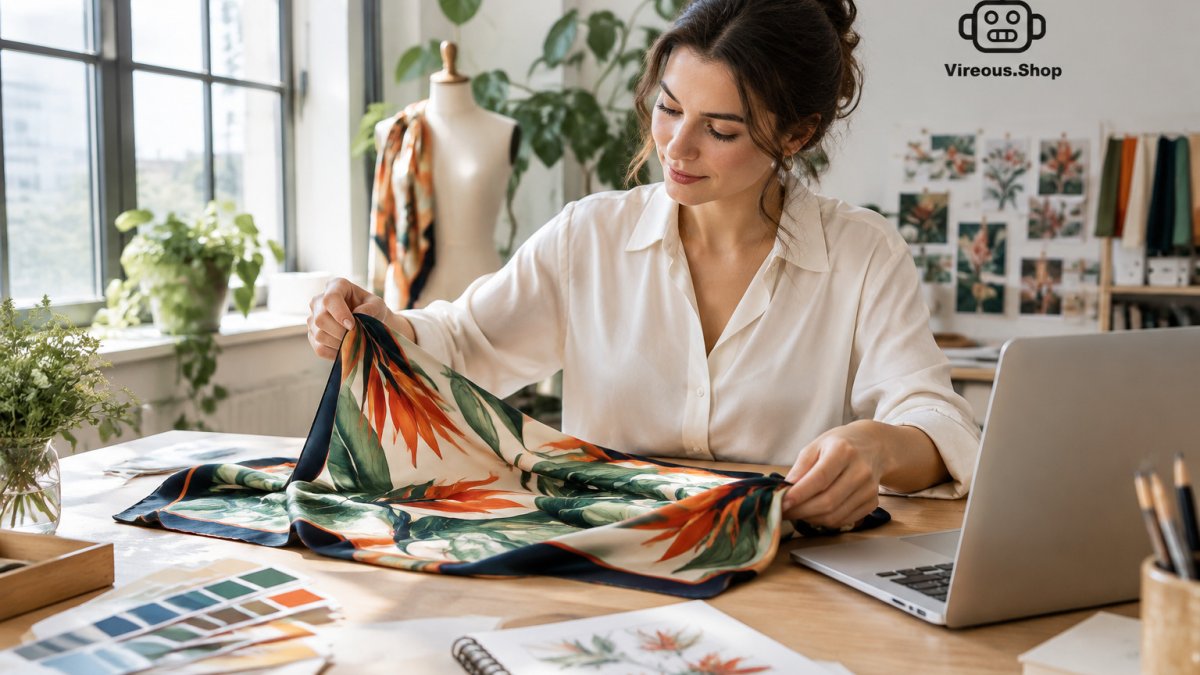 Woman styling a bold botanical print silk scarf over a cream blouse in a bright, sunlit design studio.
Botanical and floral. A single large bloom centered on a square reads as a statement piece, while a scattered leaf repeat feels quieter and more everyday. For weddings, a watercolor floral in the event palette with names or a date worked into a border is a common pattern. Watch out: dense floral repeats can turn muddy when the scarf is knotted, so keep the scale large enough that individual blooms stay legible.
Abstract and painterly. Loose brushstrokes, color fields, and gestural marks work well for creators building a visual identity. These designs tolerate cropping and folding because there is no single focal point to lose. They suit digital printing, which handles gradients and blended edges better than screen methods.
Geometric and architectural. Grids, stripes, and repeating tiles give a crisp, modern look and are forgiving to produce because alignment is predictable. A border frame with a repeated small motif along the edges and an open center for a logo or short phrase is a reliable structure for corporate gifts and commemorative pieces.
Heritage and equestrian. Classic scarf patterns often use a central medallion, corner motifs, and a bordered field. This layout suits symmetrical artwork and reads well when folded into a triangle or tied at the neck. It is a good choice when the scarf needs to look traditional across seasons.
Photographic and collage. A single hero image with generous margins works for portraits and detailed illustrations. Photo collages can feel busy, so limit the number of images and unify them with a shared color treatment.
Logo-repeat and brand patterns. For corporate gifting, a repeated logo or a subtle brand pattern keeps the scarf wearable beyond the event. Place the primary logo away from the edges, where a knot can hide it, and consider a secondary mark for the corners.
Occasion shapes the palette and scale as much as the motif. For weddings, soft florals and watercolor patterns in the wedding palette travel well. For corporate gifts, quieter palettes and classic patterns tend to suit more recipients. For a museum gift shop or a stylish personal wardrobe, an abstract artwork print from your own sketches or photographs often feels most special. A bold print suits a creator building a visual identity, while a quieter palette and a classic pattern tend to travel better across different outfits and seasons.
Planning Your Design: A Practical Workflow for a Custom Silk Scarf
Good results start before you upload anything, so work through these custom printed silk scarf design ideas steps in order:
-
Define the purpose. Decide whether the scarf is for personal wear, a gift, a brand item or a collection, because this shapes how bold and how repetitive the design should be.
-
Gather your artwork. Collect the photos, sketches, patterns or logo files you plan to use, and note their original dimensions and resolution.
-
Sketch the layout. Place rough shapes on a square to see how the pattern repeats and where the focal point falls.
-
Test the palette. Limit yourself to a small set of colors, and check how they look on a light and a dark background.
-
Preview before ordering. Use the design tool to view the scarf in its final proportions and correct any cropping or scale issues.
Choosing the Right Scarf Size and Shape
Square scarves are the most common choice for custom printing because the design wraps evenly and works in several knots. A larger square gives more room for a full-scale artwork, while a smaller one suits a pattern repeat or a pocket square. Consider where the scarf will be worn: a long, narrow shape reads differently around the neck than a square folded into a bag.
Match the size to the design. Large, single images need space to breathe, so a bigger format is better. Small repeating motifs can fill a smaller piece without looking crowded. Check the size options on the product page before finalizing your layout, since the same artwork can look very different across formats.
Color, Scale, and Layout Guidance
Scale changes everything. A motif that looks elegant at thumbnail size can overwhelm a scarf when printed large, so view your design at full dimensions before approving it. Keep the most important element away from the edges, where it can be hidden by a knot.
For color, pick two or three dominant shades and one accent. Silk tends to show color richly, so very bright combinations can look intense. Neutral grounds with a single bold accent are a reliable starting point. For layout, balance is key: a centered focal point suits symmetrical designs, while an offset composition feels more relaxed and modern.
Silk Scarf Design Templates You Can Adapt
A template gives you a working structure to customize rather than a blank canvas. Three approaches work well:
-
Border frame: Place a repeated small motif along the edges and leave the center open for a portrait, logo or short phrase. This suits gifts and commemorative pieces.
-
Repeat pattern: Tile a single icon or illustration across the whole surface in a regular grid. It is easy to produce and forgiving of small alignment differences.
-
Single hero image: Center one strong artwork with generous margins. This works well for photographs and detailed illustrations.
To adapt any template, replace the placeholder elements with your own artwork, adjust the color palette to match your brand or occasion, and preview the result before you order. Templates are most useful as a starting point, since your own images will always carry more personality than a default layout.
Print-Ready Artwork Specifications and Silk Printing Methods
Preparing artwork properly prevents disappointment. Use the highest resolution file you have, ideally at least 300 dpi at the intended print size, and save in a lossless format such as PNG for graphics with flat color. Vector files (SVG or AI) are the best choice for logos because they scale without losing sharpness. Photographs should be cropped to the final scarf proportions before upload so you control exactly what appears.
Beyond resolution, a few specifications matter for textile printing. Bleed is the extra image area beyond the final cut line; without it, slight cutting shifts can leave a white edge. Safe areas are the margins inside the cut line where important elements should sit so they are not clipped. For a square scarf, keep critical content away from the outer edge by a margin proportional to the scarf size. If your design is a repeating pattern, set up a repeat tile that matches the scarf dimensions so the motif aligns at the seams and edges.
Color profiles also affect the result. Screen color and printed color differ, and bright blues and deep reds can shift on fabric. Compare your preview with the expected output and avoid relying on extremely fine lines below about 1 mm, which can blur on textile. A common pattern is to convert artwork to the printer's recommended profile before upload rather than relying on the screen appearance alone.
Silk printing methods shape the final look.
Care and durability tie back to these choices.
The key artwork specs to check before uploading are summarised below.
| Specification |
Value |
Note |
| Resolution |
300 dpi at print size |
Use the highest resolution file you have |
| Preferred format for logos |
SVG or AI |
Vector files scale without losing sharpness |
| Graphics with flat colour |
PNG |
Lossless format |
| Bleed |
Extra image area beyond the cut line |
Prevents white edges after cutting |
| Fine lines |
Avoid below about 1 mm |
Thin lines can blur on textile |
Custom Silk Scarf Printing With No Minimum: What to Expect on Cost and Timing
Cost depends on size, design complexity and quantity. Check the current pricing on each product page before ordering, since prices can change and we do not want to quote figures here that may fall out of date.
For planning, allow time for artwork review, your preview approval and production before the date you need the scarf. Ordering early gives you room to correct any file issues.
Order Your Custom Silk Scarf Design and Start Creating Today
A custom printed silk scarf is a practical way to turn your artwork into something you can wear, gift or sell as part of your brand. Start by choosing a clear purpose, preparing high-resolution artwork and previewing your layout in the design tool.
 Create Your Own Design All-Over Print Sleeveless Dress on White
Ready to begin? Start designing your custom item at Vireous.Shop, where our online tools let you customize your own design and see the result before you order.
Frequently Asked Questions
What are the best file formats for custom silk scarf printing?
Supplying artwork at the final product dimensions helps avoid scaling problems, and keeping a layered original lets you adjust colors or repositioning without starting over.
How do I choose the right silk fabric for a custom scarf?
Silk twill and habotai are common choices for printed scarves because they take color well and hold a crisp image. Chiffon is lighter and drapes more loosely, which can soften the print edges. Ask the printer which base fabric suits your design, since dense, high-detail artwork often looks best on a smoother weave. Request a sample swatch when you can, so you can see how your colors read on the actual cloth.
Can I use AI-generated art for custom silk scarf designs?
Yes. AI-generated art can be used for a custom scarf as long as you hold the rights to use the image commercially and the output meets the printer's resolution requirements. Generate the design at a high resolution and check that fine details hold up when enlarged to the scarf size. Test a small sample print first, because gradients and tiny patterns sometimes shift in color on silk.
Are there minimum order quantities for custom silk scarves?
Minimums vary by provider. Some custom print services accept single-item orders, while others set a minimum per design or per batch. Check the ordering terms before you upload artwork, and ask whether bulk pricing applies if you plan to order for a team, event, or gift set. Factor in production time as well, since rush timelines may add cost.