

Table of Contents
- How AI Home Styling Learns Your Aesthetic Preferences
- AI Interior Design Tools for Homeowners: What They Actually Do
- The Benefits of AI-Generated Wall Art for Personalized Spaces
- Time, Cost, and Design Iteration: Where AI Delivers Real Gains
- Data Privacy and Security in Home Scanning
- Best Practices for AI-Assisted Interior Design
- What AI Home Styling Still Can't Do
- Frequently Asked Questions
Last Updated: September 28, 2026
How AI Home Styling Learns Your Aesthetic Preferences
Most tools learn your taste in three ways:
- Style quizzes and onboarding questions that establish a baseline
- Behavioral signals like which designs you save, share, or purchase
- Iterative prompts where you refine a description until it matches your vision
The learning curve is real, though. Early suggestions often miss the mark, and the system needs a handful of interactions before patterns emerge.
AI Interior Design Tools for Homeowners: What They Actually Do
Homeowners now have access to tools that were once reserved for design professionals. The practical question is what these tools actually deliver versus what marketing promises.
Space Planning and Layout Suggestions Without a Designer
Space planning tools analyze room dimensions and traffic flow, then propose furniture arrangements that fit. You upload a photo or enter measurements, and the tool generates layout options with furniture placement. This works well for standard rectangular rooms. Odd-shaped spaces, awkward alcoves, and structural quirks still trip up most systems.
Color Palette Generation and Furniture Arrangement
Color palette generation pulls from your existing decor photos or stated preferences and produces coordinated schemes. Furniture arrangement tools then suggest pieces that match. The output is a starting point, not a finished room. Treat it as a first draft you refine.
| Task | What AI Does Well | Where It Falls Short |
|---|---|---|
| Space planning | Standard room layouts, traffic flow | Odd shapes, structural limits |
| Color palettes | Coordinated schemes from photos | Nuance in natural vs. artificial light |
| Furniture arrangement | Style-matched suggestions | Real-world clearance and scale |
| Visualization | Fast 3D mockups | Exact material textures |
The Benefits of AI-Generated Wall Art for Personalized Spaces
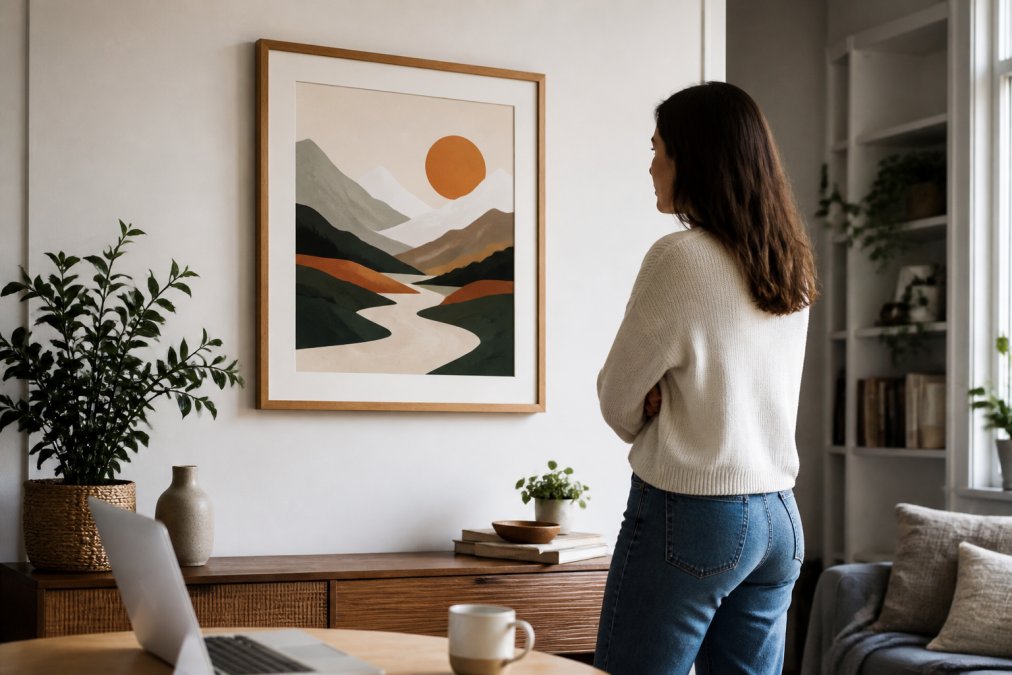
AI-generated wall art solves a specific problem: finding a piece that matches your space without commissioning an artist or settling for mass-market prints. Vireous.Shop offers framed prints generated from text prompts, so you can describe a scene and receive a finished piece.
From Text Prompt to Framed Print: How It Works
The process is straightforward. You write a description, the system generates design options, you pick one, and it gets printed and framed. Vireous.Shop uses OpenAI's technology to power this generation, and products like the Mars and Venus as Robots framed print show the range: a classical composition reimagined with a modern twist.

Matching a Generated Print to the Room, Not Just the Prompt
The gap most guides skip is the handoff between a generated image and a wall. A prompt that produces a striking image on screen can still fight the room once it is framed and lit. Three variables decide whether a print lands:
- Palette temperature. Pull two or three hex values from your existing textiles or paint and name them in the prompt. A print that shares undertones with your sofa reads as intentional; one that clashes reads as an afterthought.
- Scale relative to wall and furniture. A large-format print above a low sofa can overwhelm the seating; a small print on a tall wall can disappear. Measure the wall span and the height of the furniture below it before you choose a size.
- Light exposure. South- and west-facing walls shift warm in late afternoon, which can mute cool blues and greens in a print. North-facing walls stay cooler and can make warm reds and oranges feel flat. If you cannot test the print in person, favor mid-tone compositions that hold up under both.
What Generated Art Does Better Than Stock, and Where It Still Loses
Compared with stock photography or mass-market prints, generated art wins on fit: you can specify subject, mood, and palette in a single prompt, and you can iterate until the composition matches the wall. That iteration is the real advantage, not the novelty of the tool.
Framing and Finishing Choices That Change the Result
Framing is not a neutral container. A wide white mat pushes a busy composition toward calm; a thin or no mat lets a bold print dominate. Wood tones in the frame should echo a secondary wood in the room, not compete with the dominant one. These are small decisions, but they are the difference between a print that looks placed and one that looks purchased.
A Practical Workflow for One Wall
Start with the wall, not the art. Photograph the wall in daylight and note the light direction. Pull your palette from the room's existing pieces. Write a prompt that names subject, mood, and two or three colors. Generate a small batch, then narrow to one. Choose a frame finish that echoes a secondary material in the room. Hang it, live with it for a week, and only then decide whether to add a second piece.
Time, Cost, and Design Iteration: Where AI Delivers Real Gains
The clearest gains from AI in home styling are speed and iteration count. Traditional design processes involve waiting for samples, scheduling consultations, and committing to decisions before you see them in context. AI compresses that loop.
Mars and Venus as Robots in the Style →
Data Privacy and Security in Home Scanning
Home scanning tools that analyze your space raise legitimate privacy questions. When you upload photos of your living room, you are sharing details about your home, your belongings, and potentially your location.
A few practical safeguards:
- Check what the tool does with your images. Reputable services state whether photos are stored, used for training, or deleted after processing.
- Read the privacy policy before uploading. Look for clear language about data retention and third-party sharing.
- Avoid uploading photos that show identifying details like street signs, mail, or security systems.
- Use tools with clear data handling policies. If a service does not explain how it handles your data, treat that as a red flag.
Best Practices for AI-Assisted Interior Design
Getting good results from AI design tools comes down to how you use them. The technology is capable, but it responds to clear direction. The two practices that separate a useful result from a generic one are keeping a human in the loop and designing for real bodies, not just rendered ones.
Keep a Human in the Loop
AI generates options. You make decisions. The best results come from treating the tool as a collaborator, not an oracle. Review every suggestion against your actual space, your budget, and how you live.
Prioritize Sustainable and Accessible Choices
Sustainability and accessibility are not afterthoughts. When choosing materials, look for certifications like FSC® for paper and wood products. When planning layouts, consider whether the space works for everyone who uses it, including people with mobility needs.
Name Your Constraints Before You Generate
The single highest-leverage habit is to write your constraints down before you open the tool. Budget ceiling, fixed pieces you cannot move, traffic paths, light direction, and any accessibility needs. Feed those into the prompt as fixed conditions rather than hoping the model guesses them. This is what separates a design session that produces three usable directions from one that produces thirty unusable ones.
What AI Home Styling Still Can't Do
AI home styling cannot replace a designer's judgment on structural changes, complex spatial problems, or projects that require permits and contractor coordination. It also struggles with rooms that have unusual architecture, significant natural light variation, or specific functional requirements that are hard to describe in text.
Frequently Asked Questions
Can AI actually help with home decor?
Yes. AI home styling tools use your input, such as room dimensions, color preferences, and style keywords, to generate layout suggestions, color palettes, and decor options. You can also use AI-generated wall art to anchor a room's look. For example, a framed print like the Mars and Venus as Robots Botticelli-inspired piece at $51.47 gives you a one-of-a-kind focal point that matches your stated aesthetic. The technology handles the heavy lifting of ideation while you make the final call.
How does AI-driven personalization improve interior design outcomes?
AI-driven personalization improves outcomes by removing guesswork. Instead of scrolling through thousands of generic products, you describe your style in plain language and get customized recommendations that fit your space, budget, and taste. This shortens the design iteration cycle from weeks to hours. You can test multiple color palettes, furniture arrangements, and wall art concepts before committing to a purchase, which reduces the chance of buying something that does not work in your home.
What are the limitations of using AI for home styling?
AI cannot physically walk your space, feel the texture of a fabric, or judge how natural light shifts throughout the day. It also struggles with highly specific accessibility requirements unless you prompt for them. Data privacy is another consideration: if a tool asks you to upload room scans, check how that data is stored and whether it is shared. AI is a strong starting point for layout suggestions and decor options, but a human review of the final plan is still necessary.
How does AI help in selecting custom wall art and decor?
AI helps by generating art that matches your exact color scheme and style preferences. You type a prompt, and the tool produces a design you can order as a framed print. Vireous.Shop uses OpenAI and DALL-E 3 to turn natural language prompts into finished pieces printed on FSC-certified paper with Mimaki UV inks. Each framed print starts at $50.12 and comes ready to hang, so you skip the gallery hunt and get wall art that fits your room from day one.
The challenge with home styling is not a lack of options. It is finding the ones that actually fit your space, your taste, and your budget without wasting time or money on the wrong choices. Vireous.Shop helps you skip that guesswork by generating custom wall art and personalized designs from simple text prompts, with made-to-order printing on FSC-certified paper and fast dispatch so your space comes together without the wait. Customize your first piece and see what your own description becomes.