

Table of Contents
- Why AI Art Is Becoming a Home Decor Choice
- The Real Benefits of AI-Generated Wall Art
- Best AI Tools for Custom Home Decor
- How to Print AI Art for Wall Decor
- Custom AI Wall Art Ideas for Different Rooms
- Legal and Ethical Considerations You Should Know
- Quality, Resolution, and Print Standards for AI Art
- Frequently Asked Questions
Last Updated: August 31, 2026
Why AI Art Is Becoming a Home Decor Choice
AI art is increasingly valued for home decor because it offers creative freedom, affordability, and personalization that traditional art cannot match. Homeowners and renters are discovering that generative art allows them to commission custom wall art tailored to their specific aesthetic without paying gallery prices or waiting months for an artist.
Rather than choosing between mass-produced prints and expensive original commissions, many now see AI-generated pieces as a legitimate middle ground: genuinely unique, completely customizable, and available within days instead of months.
At Vireous.Shop, we've watched this transition firsthand. Our platform enables customers to generate custom designs using natural language prompts or select from a library of AI-inspired masterpieces, then receive high-quality printed canvas art with same-day or next-day dispatch. You describe the aesthetic you want, the tool creates variations, and you get a finished piece ready to hang.
This guide explores whether AI art is good for home decor, examining the real benefits, the tools that deliver results, the technical requirements for quality prints, and the ethical considerations you should understand before filling your walls.
The Real Benefits of AI-Generated Wall Art
The advantages of AI art for home decor break down into three concrete categories: customization depth, cost efficiency, and speed of execution.
Unlimited customization is the most compelling benefit. Traditional wall art forces you to choose from what exists. AI art lets you describe exactly what you want, a specific color palette, artistic style, subject matter, mood, or combination of elements, and generate variations until something clicks. A homeowner wanting abstract art in shades of teal and gold with an impasto texture can get exactly that, not a close approximation from a limited catalog.
Personalization at scale changes what's possible for different rooms. Your bedroom might feature calm, meditative generative art. Your office could display bold, geometric pieces. Your gallery wall could mix styles and moods that reflect your actual taste. This level of customization traditionally required hiring an interior designer or commissioning multiple artists, both expensive and time-intensive.
Cost structure is straightforward. AI-generated canvas prints through platforms like Vireous.Shop offer significant savings compared to original artwork, limited-edition prints, or mass-market gallery pieces. You're paying for the print quality and production, not for scarcity or an artist's reputation. Multiple pieces become feasible for a single room or throughout your home.
Speed of execution eliminates the waiting game. From prompt to finished canvas in hand can happen within 24-48 hours. This matters for renters who can't commit to permanent installations, for people redesigning spaces quickly, or for gift-givers who realized too late what they wanted to give.
Best AI Tools for Custom Home Decor
When choosing a tool for generating AI art, the decision hinges on ease of use, integration with printing services, and output quality.
Vireous.Shop integrates DALL-E 3 through OpenAI's API, combining the design generation step with print production in one workflow: you write a prompt, refine the output, approve a preview, and the finished canvas ships same-day or next-day. The user-friendly design interface lets you experiment with prompts without technical knowledge.
The real advantage of AI art tools for home decor isn't just the generator, it's the integration with print fulfillment. Vireous.Shop handles that end-to-end, so you're not exporting files, finding a print service, managing quality concerns, or dealing with separate vendors. This eliminates friction points that many people struggle with when generating beautiful AI art separately from printing.
Other standalone generators like DALL-E, Midjourney, or Stable Diffusion give you more control and can produce stunning work, but they require you to handle printing separately. You'll need to understand upscaling, file formats, DPI requirements, and find a print partner. For experienced users, this flexibility is valuable. For most people decorating their home, it's an unnecessary complication.
How to Print AI Art for Wall Decor
Printing AI-generated art requires understanding a few technical specifications that separate a crisp, vibrant final product from a disappointing one.
Resolution and DPI are the foundation. Most AI generators create images at 1024×1024 pixels, roughly equivalent to 1 megapixel (peer-reviewed research). For printing, professional standards call for 300 DPI (dots per inch) at your final print size (nist.gov). A 16×20 inch canvas at 300 DPI requires approximately 4,800×6,000 pixels (nist.gov). Your 1024-pixel image falls far short.
Upscaling bridges that gap. Upscaling tools use AI to intelligently enlarge images while preserving detail and sharpness. Services like Topaz Gigapixel, Let's Enhance, or built-in upscaling within print platforms can take your 1024-pixel AI image and scale it to 4,800+ pixels with minimal quality loss. Many print-on-demand services now include upscaling automatically. Vireous.Shop handles this as part of the workflow, so you don't manually upscale or worry about DPI calculations.
Canvas quality matters more than people expect. Premium canvas uses 100% polyester or cotton-blend fabric stretched over wooden frames, with UV-resistant inks and proper tensioning to prevent sagging. Vireous.Shop uses premium satin canvas with wooden inner frames and metallic mounts, designed for long-term color stability and visual impact.
Practical steps for printing AI art:
- Generate your AI artwork at the highest resolution your tool offers
- If printing at a large size (20+ inches), use an upscaling service or platform that includes upscaling
- Confirm the final resolution meets 300 DPI at your intended print size
- Choose a print partner that uses premium canvas and quality inks
- Review a digital preview before approving production
Custom AI Wall Art Ideas for Different Rooms
The aesthetic you choose for AI-generated art depends on the room's function, existing decor, and the mood you want to create.
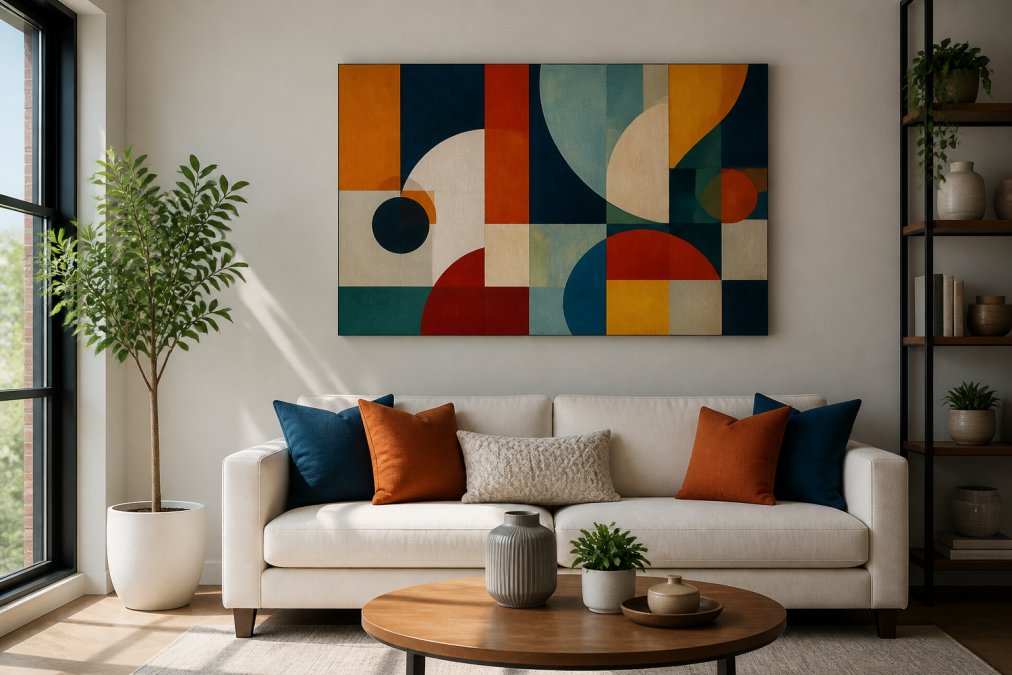
Living rooms typically work best with bold, visually engaging pieces that serve as focal points. Abstract art with rich color palettes, deep blues and golds, warm terracottas and creams, or jewel tones, draws attention without overwhelming the space. Many people use AI to generate gallery walls: multiple pieces in complementary styles that create visual harmony. Prompts like "abstract geometric art in shades of teal and copper with metallic accents" give you the exact aesthetic you're after.
Bedrooms benefit from calmer, more meditative compositions. Soft palettes, nature-inspired generative art, or minimalist geometric patterns work well. Prompts focusing on peaceful imagery create an environment conducive to rest.
Home offices and workspaces often feature art that energizes without distracting. Structured abstract work, bold color combinations, or motivational imagery works here. A tech professional might choose digital-looking geometric art; a creative might prefer vibrant, chaotic abstract pieces.
Hallways and entryways are ideal for statement pieces or series of smaller prints. These transitional spaces can handle bolder choices than living areas.
The key is matching the AI art style to the room's purpose and existing decor. Vireous.Shop lets you experiment with multiple prompts and preview how pieces look before printing.
Legal and Ethical Considerations You Should Know
The legality and ethics of AI-generated art for personal use remain unsettled in many jurisdictions, and understanding the landscape matters before you commit to decorating your home with AI pieces.
Copyright and ownership is the primary concern. When you generate art using DALL-E, Midjourney, or similar tools, who owns the resulting image? OpenAI's terms state that users own the images they create through DALL-E, provided they follow the usage policy. Vireous.Shop operates under OpenAI's licensing, which means your generated artwork is yours to print and display personally. For personal home decor, you're generally on solid ground.
Ethical considerations around training data are worth acknowledging. Most generative AI models are trained on vast datasets of existing artwork, photographs, and images scraped from the internet. Artists whose work was included in that training data were typically not compensated or asked for permission. If this concerns you, it's reasonable to consider it when choosing whether to use AI art. Vireous.Shop products are clearly labeled as "Designed by AI," which handles this transparently.
Attribution and disclosure matter if you're using AI art in contexts beyond personal home decoration. If you're posting your AI-generated wall art on social media, many platforms and audiences expect you to disclose that it's AI-generated.
Future regulatory changes are possible. As AI art becomes more prevalent, governments may introduce regulations around disclosure, copyright, or usage rights. Staying informed about changes in your jurisdiction is prudent if you're investing in AI art as part of your home's aesthetic.
For personal home decor use, the legal and ethical picture is relatively clear: you can generate, print, and display AI art in your home without major concerns, provided you use a reputable platform with clear licensing terms like Vireous.Shop.
Quality, Resolution, and Print Standards for AI Art
The difference between an AI artwork that looks stunning on your screen and one that impresses on your wall comes down to technical execution: resolution, upscaling, print method, and material quality.
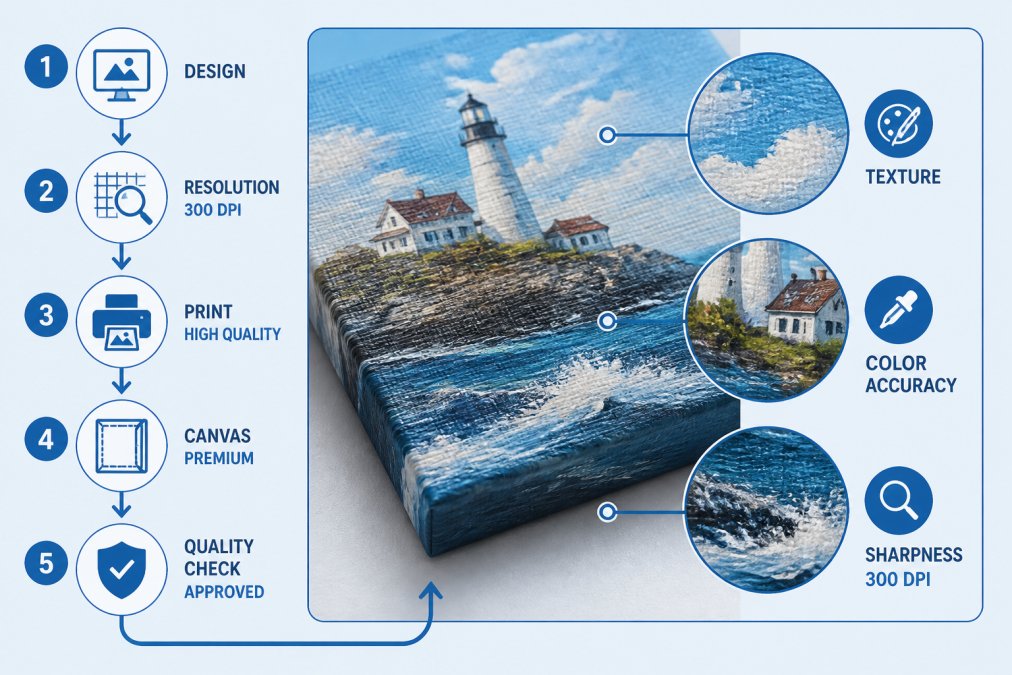
Starting resolution from most AI generators is 1024×1024 pixels (roughly 1 megapixel). This works for screen display but falls short for wall art. A 16×20 inch canvas requires approximately 4,800×6,000 pixels at 300 DPI to print without visible pixelation.
Upscaling technology bridges that gap. Modern upscaling uses AI models trained to intelligently enlarge images while preserving detail and minimizing artifacts. Vireous.Shop includes upscaling as part of its workflow, managing resolution requirements based on your chosen canvas size.
DPI (dots per inch) is the standard measure of print resolution. Professional printing typically targets 300 DPI for photo-quality results. At 150 DPI, images begin to show visible pixelation to the naked eye. For AI art, which often features bold colors and abstract shapes, slightly lower DPI (200-250) can work acceptably, but 300 DPI remains the gold standard.
Canvas material affects how your art looks and lasts. Premium canvas uses tightly woven polyester or cotton blends that hold color and resist fading. UV-resistant inks are essential if your art receives significant natural light. Vireous.Shop uses premium satin canvas with fade-resistant inks, designed for longevity.
Print method matters. Giclée printing (high-quality inkjet) is the standard for fine art reproduction. Pigment-based inks last longer and resist fading better than dye-based alternatives.
Color accuracy is often overlooked but critical. Your digital preview and your printed canvas should match. Reputable print services use calibrated monitors and printers to ensure consistency. Vireous.Shop includes a digital preview step so you can approve colors before production.
Practical checklist for quality AI art printing:
- Confirm your upscaled image is at least 300 DPI at your final print size
- Choose a print service using pigment-based inks and premium canvas
- Request a digital preview and approve colors before production
- Opt for giclée or equivalent high-quality printing methods
- Select UV-resistant finishes if your art will receive direct sunlight
The question of whether AI art is good for home decor has a straightforward answer: yes, when you approach it strategically. AI-generated artwork solves real problems, unlimited customization, affordability, and speed, while delivering quality comparable to traditional prints when printed properly.
Start by generating a few pieces with different prompts and styles. Approve previews before production. Invest in proper upscaling and premium printing to ensure your finished canvas matches your vision. Vireous.Shop handles the end-to-end workflow, from prompt to printed canvas, with same-day or next-day dispatch, Money Back Guarantee, and integration with OpenAI's DALL-E 3 for reliable, high-quality generative art. Customize your wall art and transform your space with pieces that reflect exactly who you are.
Frequently Asked Questions
Can I legally use AI-generated art for my home decor?
Yes, you can use AI-generated art for personal home decor in most cases. When you generate art using tools with proper licensing agreements (like DALL-E 3), you typically receive usage rights for the images you create. However, always review the terms of service for the specific AI tool you use. Some platforms grant you full ownership, while others may have restrictions on commercial use or resale. For personal wall art, you're generally in the clear as long as you're not violating the platform's terms.
How do I get high-resolution AI art suitable for printing?
Most modern AI art generators produce images at standard resolutions (typically 1024x1024 pixels or higher). For wall art, you'll want at least 300 DPI (dots per inch) for sharp prints. If your AI-generated image is lower resolution, upscaling tools can enlarge it while maintaining quality. When ordering prints, specify your desired wall size and let the printing service handle the resolution requirements. Services like those offered through Vireous.Shop handle upscaling and quality optimization automatically, ensuring your AI art looks crisp and vibrant on canvas.
What makes AI art different from traditional wall art for home decor?
AI art offers unlimited customization and personalization through prompt engineering, you describe what you want and the AI generates it instantly. Traditional art is static once created, but AI art can be regenerated with different styles, colors, or themes to match your evolving decor. AI art is also typically more affordable and faster to produce than commissioned pieces. The main trade-off is that AI art lacks the human artistic intent and emotional narrative of hand-created work, though many homeowners find the personalization and accessibility worth it.
How quickly can I get AI art printed and delivered for my walls?
AI art generation itself takes minutes to hours depending on the tool and complexity. Once generated, printing and delivery times depend on your provider. Many services, including Vireous.Shop, offer same-day or next-day dispatch for personalized canvas prints and wall art. This speed is possible because the art is generated digitally and printed on-demand, there's no inventory or long production queues. Rush shipping options may be available if you need your custom wall art even faster, making AI art an excellent choice for last-minute decor updates or gifts.
This article was written using GrandRanker