

Table of Contents
- What DALL-E 3 Brings to Fashion Design
- AI Fashion Design Prompts That Actually Work
- Building Your Design Workflow with DALL-E 3
- Best Practices for AI Fashion Generation
- Limitations and When to Use Traditional Design
- DALL-E 3 vs. Specialized Fashion AI Tools
- From AI Generation to Production-Ready Designs
- Conclusion
Last Updated: August 10, 2026
What DALL-E 3 Brings to Fashion Design
DALL-E 3 transforms fashion design by delivering coherent illustrations that respond precisely to detailed prompts. Unlike earlier image generation models, it excels at anatomical accuracy and textile realism, turning ideation from hours of work into rapid iteration cycles where designers generate dozens of silhouette variations, pattern explorations, and color combinations in minutes.
The platform understands fashion-specific terminology with remarkable precision. When you describe an "asymmetrical A-line midi skirt with pleated panels and a high waistband," DALL-E 3 interprets spatial relationships and structural details accurately, reducing the gap between conceptual intent and visual output. For fashion designers and brands like Vireous.Shop that power custom apparel generation, this means fewer iterations needed to reach production-ready concepts.
The real advantage emerges when layering multiple constraints: fabric type, silhouette, color palette, and mood. DALL-E 3 maintains consistency across these parameters, making generated images genuinely useful as design references. A designer can specify "structured wool suiting with a nipped waist, 1950s tailoring references, matte finish, charcoal gray" and receive outputs that actually reflect those specifications.
AI Fashion Design Prompts That Actually Work
Effective prompts follow specific structural patterns. Generic requests like "design a cool dress" produce mediocre results; precision generates excellence.
Prompt Structure for Garment Silhouettes
Silhouette prompts require three core components: garment type, structural details, and reference context. Start with the specific garment category, "cropped linen blazer" rather than "clothing." Layer structural specifications: "single-breasted, notch lapels, dropped shoulders, tapered sleeves." Finally, add reference context: "inspired by 1990s minimalism" or "contemporary oversized tailoring."
A complete silhouette prompt reads: "A structured wool-blend overcoat with a single-breasted closure, long lapels, and a slightly oversized cut through the shoulders. Straight sleeves with functional cuffs. Hits mid-thigh. Contemporary tailoring with subtle 1970s inspiration. Medium gray fabric with visible weave texture."
This approach works because it mirrors how fashion professionals communicate design intent. Specific construction details like "dropped armhole" produce better results than vague descriptors like "relaxed fit." "Bias-cut panel at the side seam" beats "flowing design."
Avoid ambiguous terms. Instead of "elegant," specify what creates elegance: "minimal seaming, clean lines, high-quality fabric appearance." Rather than "modern," describe specific contemporary elements: "straight proportions, minimal ornamentation, matte finishes."
Textile and Pattern Specifications
Textile descriptions determine whether generated garments read as production-viable. Specify fabric weight, finish, and visual characteristics. "Heavyweight linen" differs dramatically from "lightweight linen." "Matte wool suiting" versus "glossy silk charmeuse" creates entirely different impressions.
Pattern prompts need equal precision. Instead of "patterned fabric," describe the actual pattern: "small-scale floral print with 2-inch repeat, navy background with cream flowers." For geometric patterns, include scale and color ratios: "vertical stripes, 1-inch width, alternating cream and sage green."
Specify surface characteristics: "brushed cotton," "crisp cotton poplin," "soft jersey knit," "structured canvas." For pattern placement, be explicit: "all-over print," "placed print on front panel only," or "gradient print fading from dark at hem to light at shoulder."
Building Your Design Workflow with DALL-E 3
Integrating DALL-E 3 into professional design workflows requires understanding where the tool adds value. The most effective approach treats AI generation as one component of a larger creative system.
From Concept to Technical Sketch
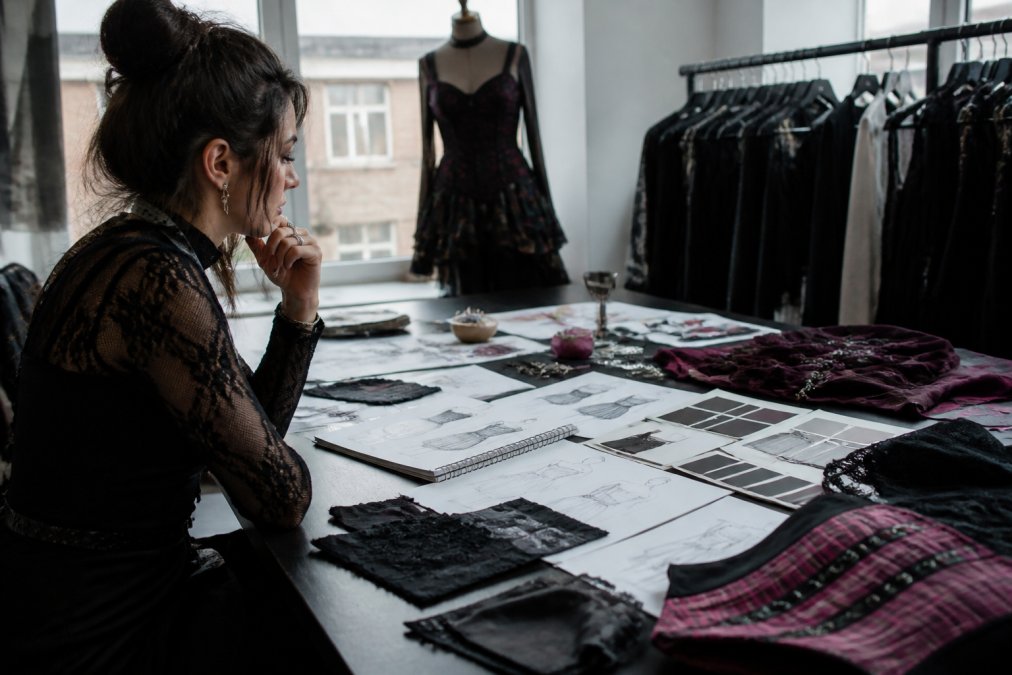
The workflow begins with concept development. Designers start with mood boards, visual references, color palettes, and silhouettes defining design direction. DALL-E 3 accelerates this phase by generating mood-board candidates directly from written descriptions. Instead of hours searching archives, generate 20 variations of "minimalist workwear aesthetic" in minutes.
From mood boards, move to silhouette exploration. Generate 10-15 variations with subtle differences: "same blazer silhouette, varying lapel widths from narrow to wide." This rapid iteration reveals which proportions feel right before committing to technical sketching.
The transition to technical sketch happens next. DALL-E 3 generates fashion illustrations, not flat technical sketches. Use generated images as reference material rather than finished technical drawings. Print the output, overlay it with a transparency sheet, and sketch the actual flat pattern from the AI-generated proportions. This hybrid approach preserves accuracy while maintaining the technical precision manufacturers require.
Post-Processing and Design Refinement
Generated images rarely emerge production-ready. Use standard image editing software to adjust color accuracy, remove background distractions, and enhance fabric texture. Add construction notes directly to images: seam placement, pocket positioning, closure details, and measurement callouts. This transforms an illustration into a working design document.
Best Practices for AI Fashion Generation
Successful AI-assisted fashion design depends on understanding both capabilities and limitations.
Achieving Aesthetic Consistency Across Collections
Collections require visual coherence. Establish a consistent design language in your prompts. If your collection emphasizes "structured tailoring with minimal ornamentation," include that phrase in every garment prompt. If color palette matters, specify those colors explicitly in each prompt.
Create a master prompt template that you modify for each garment. Start with foundational elements: "Contemporary minimalist aesthetic, structured proportions, high-quality fabric appearance, neutral color palette with strategic accent colors." Then add garment-specific details. This ensures every generated piece shares visual DNA while allowing individual variation.
Reference previous generated pieces in new prompts: "Similar tailoring approach to the previous blazer, but applied to a long coat" maintains proportional consistency across different garment types.
Rapid Prototyping and Design Iteration
Generate 20 variations of a concept, evaluate them, identify strongest directions, then generate refined variations. This cycle happens in hours instead of weeks.
Build feedback loops into your process. Share initial concepts with collaborators or potential customers. Use their feedback to refine prompts: "The first version's neckline was too high, generate variations with lower, more scooped necklines."
Document successful prompts. When DALL-E 3 produces excellent output, save the exact prompt. These become templates for future variations.
Limitations and When to Use Traditional Design
DALL-E 3 excels at visualization and ideation but struggles with certain technical aspects. The model cannot generate accurate technical flats, the standardized, dimensioned drawings manufacturers require. Beautiful fashion illustrations may distort proportions for aesthetic impact.
Seam placement accuracy is unreliable. Complex construction details, princess seams, insert panels, or intricate closures often appear in illogical locations. For straightforward construction (simple t-shirts, basic pants), AI generation works well. For complex structured pieces, rely on traditional pattern drafting.
Fabric behavior is guessed rather than known. DALL-E 3 cannot predict how specific fabrics drape or how seams sit on actual bodies. Physical sampling remains essential.
Combine both methods: use DALL-E 3 for rapid silhouette exploration and mood development, use traditional pattern drafting for technical precision and manufacturing specifications.
DALL-E 3 vs. Specialized Fashion AI Tools
| Tool | Best For | Strengths | Primary Limitation |
|---|---|---|---|
| DALL-E 3 | General fashion concept generation | Exceptional prompt understanding, diverse style capabilities, integration with Vireous.Shop | No technical flat generation, requires post-processing |
| Specialized fashion tools | Technical specification-focused design | Built-in garment templates, automatic flat generation | Limited creative flexibility, smaller style range |
| Hybrid approach | Professional production workflows | Combines AI ideation with technical precision | Requires multiple tools and workflow integration |
DALL-E 3's primary advantage is creative flexibility. You can generate anything from avant-garde couture to practical workwear, from historical references to futuristic concepts. Specialized tools constrain you to predefined templates and style categories.
Integration matters significantly. Platforms like Vireous.Shop that build DALL-E 3 directly into their generation pipeline eliminate friction between tools. You describe your vision, the system generates it, and production-ready output moves toward manufacturing without manual file transfers.
From AI Generation to Production-Ready Designs
Bridging the gap between beautiful generated image and manufacturable garment requires specific technical steps.
Technical Textile Mapping for Manufacturing
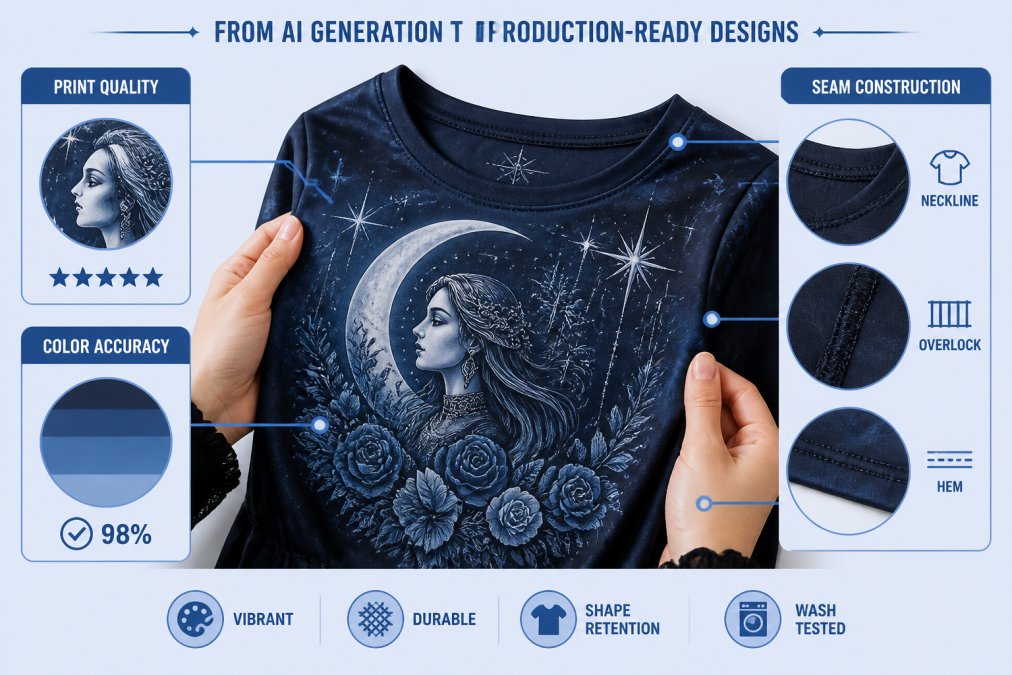
Textile mapping translates visual specifications into production requirements. When DALL-E 3 generates "structured wool suiting," you need actual fabric specifications: weight, fiber content, finish type, and color matching standards.
Create a textile reference library. For each fabric type you use repeatedly, maintain samples with documented specifications. When you generate a garment with "crisp cotton poplin," reference your library to identify the actual fabric matching the visual appearance.
Color accuracy requires systematic approach. Generated images display colors on screens with specific profiles. Printed garments render colors differently based on fabric type, dye lot, and printing method. Create color bridges, physical swatches showing how screen-displayed colors translate to actual printed output.
Maintain an active list of available fabrics with documented specifications, then reference that list when writing generation prompts. "Heavyweight linen in natural cream, available from supplier X" is better than hoping to find a fabric matching a generated image.
Sustainability Considerations in AI-Assisted Design
Use AI generation to reduce physical sampling. Instead of producing 5-10 physical prototypes to explore silhouette variations, generate 20 digital variations, select the 2-3 strongest directions, then produce physical samples only of those refined concepts.
Consider fabric waste implications during design. Complex seam placement or unusual silhouettes create more pattern waste. Simpler silhouettes with fewer seams typically waste less fabric.
Specify sustainable materials in generation prompts when relevant. "Organic cotton jersey" or "recycled polyester" ensures generated designs use materials aligned with your sustainability goals. Prioritize durability and quality, designs built to last reduce overall environmental impact.
The future of fashion design integrates human creativity and AI generation strategically. DALL-E 3 accelerates ideation and visualization, freeing designers to focus on refinement, technical precision, and human judgment that transforms concepts into garments people actually want to wear.
When you're ready to transform AI-generated designs into physical products, platforms like Vireous.Shop's AI-powered design marketplace handle the production pipeline seamlessly. The platform integrates DALL-E 3 directly into the design and manufacturing workflow, meaning your concepts move from generation to custom apparel without manual file transfers or quality inconsistencies. Start with concept generation, refine designs through rapid iteration, and move directly to production-ready output without the traditional gaps that plague design-to-manufacture workflows.
Frequently Asked Questions
How do I write DALL-E 3 prompts that actually produce wearable fashion designs?
Start with specific garment type (e.g., 'oversized blazer'), add silhouette details ('dropped shoulders, cinched waist'), then layer aesthetic descriptors ('cyberpunk, iridescent', 'minimalist, monochrome'). Include fabric hints ('silk charmeuse', 'structured cotton') and avoid vague terms. Test prompts iteratively, refine based on output. Strong prompts mention mood board references, color palettes, and design era when relevant to your collection concept.
Can I use DALL-E 3 generated images for commercial fashion products?
Yes. DALL-E 3 grants you commercial usage rights for all images you generate, including the right to print and sell designs on apparel and merchandise. You own the copyright to your generated images. However, ensure your prompts don't reference trademarked characters, celebrity likenesses, or copyrighted designs. Always review OpenAI's usage policies for any brand-specific restrictions before scaling production.
What are the main limitations of DALL-E 3 for technical fashion sketching?
DALL-E 3 struggles with precise technical specifications: complex seam placements, exact pocket positioning, and intricate pattern repeats often appear inconsistent. It's less reliable for technical flats (flat technical drawings) than for conceptual mood board imagery. For production-grade technical sketches, use DALL-E 3 for initial concept visualization, then hand-refine technical details in design software like Adobe Illustrator or Clo 3D before manufacturing.
How does DALL-E 3 compare to specialized AI fashion design tools?
DALL-E 3 excels at rapid concept visualization and mood board generation with natural language prompts. Specialized tools (like Clo 3D or Marvelous Designer) offer superior technical accuracy and 3D garment simulation but require steeper learning curves. DALL-E 3 is faster for ideation; specialized tools are better for production-ready technical specs. Many designers use DALL-E 3 for initial inspiration, then transition to specialized software for refinement.
Can DALL-E 3 generate consistent fashion characters and silhouettes across a collection?
Consistency is challenging but achievable with discipline. Use identical prompt structures, specify the same model/character name across prompts, and lock in specific parameters (body type, pose, lighting). Save successful prompts as templates. However, DALL-E 3 introduces natural variation, expect 10-15% inconsistency even with identical prompts. For true consistency, generate multiple versions of each design, select the strongest, and use post-processing software to harmonize colors and proportions across your collection.
What's the fastest way to turn DALL-E 3 concepts into actual apparel?
Generate your concept in DALL-E 3, export the image, use image editing software (Photoshop, Canva) to clean up the design and prepare it for print-on-demand. Platforms like Vireous.Shop integrate DALL-E 3 directly, letting you generate, customize, and order printed apparel in one workflow, same-day or next-day dispatch available. This eliminates the traditional gap between digital design and physical product, cutting production time from weeks to hours.
This article was written using GrandRanker